
Vintage Clothing Identification Guide for Online Sellers
An evidence-based vintage clothing identification workflow covering labels, RN research, garment construction, fibre, care, dating ranges, measurements, condition and listing language.
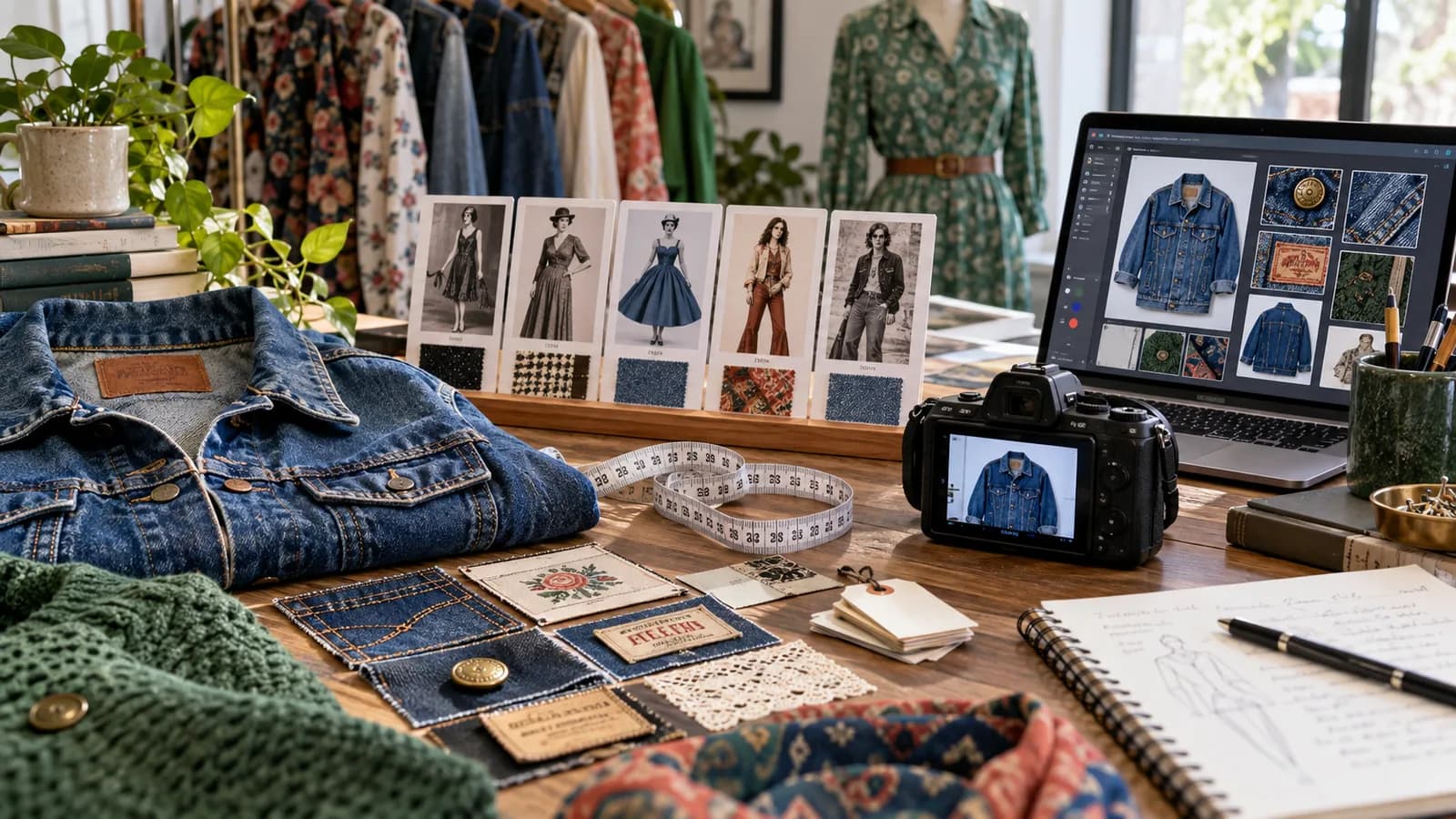
Vintage clothing identification is the process of describing a garment from evidence: labels, maker information, construction, materials, closures, care instructions, measurements, condition, provenance, and comparison with documented examples.
No single clue reliably dates every garment. Labels can be replaced, designs can be reproduced, brands can reuse logos, and old stock can be sold years after manufacture. The safest listing distinguishes verified facts from a supported estimate.
This guide helps online sellers build an identification record, narrow a likely period, describe uncertainty honestly, and translate research into searchable marketplace data.
Key Takeaways
- Start with the physical garment and photograph every label, closure, construction detail, repair, and condition issue.
- Treat brand, RN, union, care, country, fibre, and size labels as separate evidence.
- An RN database record can identify a business but does not alone prove the garment's production year.
- Date from several independent clues and provide a range when evidence is incomplete.
- Distinguish original vintage, deadstock, reproduction, vintage-inspired, altered, and upcycled items.
- Do not infer fibre content, country, designer, or era from appearance alone.
- Report label size and actual garment measurements.
- Use modern style terms only when they accurately describe appearance; do not present them as historical label terminology.
- Photograph all material wear and disclose repairs, odour, storage marks, and fabric weakness.
- Preserve provenance and research sources.
- Use qualified language such as “likely,” “consistent with,” and “estimated” where appropriate.
- Never use an unverified brand or decade merely for search traffic.
Define “Vintage” for the Listing
Marketplaces, buyers, and sellers may use “vintage” differently. Check the current platform's eligibility rule before listing.
Internally classify the item:
- Confirmed period vintage: strong date evidence
- Estimated period vintage: several consistent clues, no exact proof
- Undated older garment: age indicators but insufficient date evidence
- Deadstock/new old stock: unused older inventory, with condition and provenance clarified
- Reproduction: later garment reproducing an earlier design
- Vintage-inspired: modern product influenced by an older style
- Altered vintage: older garment materially changed
- Upcycled vintage: older material or garment redesigned
- Antique: use only when the age and marketplace context support it
Do not use “deadstock” to mean merely unworn. Explain whether tags, packaging, storage, and provenance support the claim.
Create an Evidence Record
Assign an internal SKU before research.
Capture:
| Evidence group | What to record |
|---|---|
| Garment | Type, silhouette, colour, pattern |
| Brand | Exact label text, logo, typography |
| Business | RN, WPL, company, importer |
| Origin | Country text exactly as shown |
| Fibre | Exact percentages and terminology |
| Care | Wording, symbols, label material |
| Size | Label size, system, region |
| Construction | Seams, hems, lining, interfacing |
| Closures | Zipper maker, buttons, snaps, hooks |
| Design | Collar, sleeve, waist, pocket, length |
| Condition | Wear, stain, odour, repair, weakness |
| Provenance | Owner, shop, receipt, archive, date |
| Measurements | Consistent garment measurements |
| Research | Source, URL/title, access date, conclusion |
Photograph the evidence before cleaning or repair. A care label can fade, a seam can be altered, and original packaging can be separated.
Photograph Every Label
Capture:
- 1Front of brand label
- 2Back of brand label
- 3Fibre-content label
- 4Care label
- 5Country-of-origin label
- 6Size label
- 7RN/WPL or business label
- 8Union label
- 9Lot, style, season, or order numbers
- 10Retail tag and price
- 11Handwritten notes
- 12Replacement or alteration evidence
Use sharp, even light. Do not crop out surrounding stitching; attachment method can reveal whether a label was replaced.
Transcribe exactly, preserving punctuation and leading zeroes.
Understand US Textile Labels and RN Records
For clothing associated with the United States, FTC sources can help interpret labels.
The FTC's apparel and labeling overview explains that most covered textile and wool products require fibre content, country of origin, and the identity of a manufacturer or responsible business. Care instructions are addressed under a separate rule.
A business may use a Registered Identification Number instead of its name. The FTC maintains an RN database.
What an RN can tell you
- The registered business name
- Business type or product information in the record
- Address and status data where available
- A research lead for brand or importer history
What an RN cannot prove alone
- Exact manufacturing date
- That the listed business made the garment
- Exact factory
- Authenticity
- Fibre or origin beyond the garment's labels
- That current database details reflect the historical period
- That the label was originally attached
FTC warns that database information depends on submitter maintenance. Record the result and use independent evidence.
Safe RN wording
Label includes RN 12345, which the FTC database associates with [business] as accessed on [date]. The RN supports company identification but does not establish the exact garment date.
Do not publish private addresses unnecessarily.
Read Fibre Content Carefully
Transcribe the fibre label exactly.
Do not replace historical or regional fibre terms with a modern assumption unless a reliable equivalence is established.
Check:
- Percentages total appropriately
- Shell vs lining
- Trim exclusions
- Wool or specialty fibre wording
- Blend order
- “Exclusive of decoration”
- Language and spelling
- Worn or missing portions
The FTC's Textile Fiber Rule describes US requirements for generic fibre names and percentages for covered products. Requirements differ by country and period.
If no label exists, use tactile or burn testing only when qualified, safe, lawful, and appropriate—and describe the conclusion as an estimate. Destructive tests are inappropriate for valuable garments without informed ownership decisions.
Country of Origin as a Dating Clue
Country wording can narrow possibilities when aligned with historical changes, but it is not a complete date.
Record exact text:
- Made in [country]
- Fabric made in one country, assembled in another
- Imported by
- Styled in/designed in
- Regional names or abbreviations
Research:
- When the business operated
- When country terminology changed
- When relevant trade labels were common
- Whether the product may be a later reproduction
Do not assume every garment was labeled under current law or that a missing origin proves age.
Care Labels and Symbols
Care labels can provide a minimum or likely date range when their form corresponds with documented regulatory or industry changes.
Record:
- Written instructions
- Symbol system
- Language
- Label placement
- Printing method
- Fibre-care consistency
- Whether label appears original
A modern-looking care label may suggest a later manufacture or reproduction, but replacement labels and regional systems exist.
Do not date solely from “dry clean only” or a familiar symbol.
Brand Label Research
Brands may use different labels by period, line, region, manufacturer, or price tier.
Compare:
- Logo spelling
- Typeface
- Colour
- Border
- Woven vs printed construction
- Sub-brand
- Store label
- Licensing language
- Trademark symbols
- Country and RN
- Attachment
Use brand archives, museum collections, catalogs, advertisements, trademark records, corporate histories, and documented collector references.
Image-search similarity is not proof. Save the source and explain which features match.
Beware label transplants
Signs include:
- New stitching through an older label
- Thread unlike surrounding construction
- Needle holes from a prior label
- Label inconsistent with garment quality
- Size/country conflict
- Brand not known for product type
- Care label much later than claimed era
Present inconsistencies rather than forcing a conclusion.
Union Labels
Union labels can be useful for garments produced within their coverage, but their design, jurisdiction, and numbering need specialist reference.
Record both sides and surrounding stitching. Research the exact union, label design, and known date range.
Do not treat “union made” as automatically valuable, rare, or US-made without further evidence.
Zippers, Buttons and Hardware
Hardware can support a date range.
Record:
- Zipper maker
- Material
- Teeth type
- Pull design
- Placement
- Button material and back marks
- Snap or hook branding
- Buckles
- Replacement evidence
A zipper patent or manufacturer period provides a possible earliest date for the component, not necessarily the garment date. Old hardware can be reused and closures can be replaced.
Use hardware as corroboration.
Garment Construction
Study:
- Seam type
- Overlocking/serging
- Pinked edges
- French seams
- Hand finishing
- Hem depth
- Lining
- Interfacing
- Shoulder pads
- Darts and shaping
- Pocket construction
- Pattern matching
- Fastener placement
- Alterations
Construction methods overlap across decades, locations, home sewing, couture, workwear, and reproductions.
A hand-sewn detail does not automatically make a garment old. Modern makers use historical techniques.
Silhouette and Design
Silhouette can suggest a period but fashions recur.
Document:
- Shoulder shape
- Waist position
- Skirt/trouser shape
- Hem length
- Collar/lapel
- Sleeve
- Closure
- Print scale
- Decorative details
Compare with dated catalogs, magazines, sewing patterns, advertisements, and museum records.
Use “1940s-style” for appearance when production date is not established; reserve “1940s” as an age claim for supported evidence.
Size Labels Are Not Modern Measurements
Historical size labels vary by country, brand, and period and may not correspond to current sizing.
Always publish the label size and actual measurements.
Tops and jackets
- Shoulder
- Chest/pit to pit
- Waist
- Hem
- Sleeve
- Back length
Dresses
- Shoulder
- Bust
- Waist
- Hip
- Bodice length
- Total length
- Sleeve
Trousers and skirts
- Waist
- Hip
- Rise
- Inseam
- Outseam
- Thigh
- Leg opening
- Length
State whether measurements are flat and whether circumference is doubled. Describe stretch and measurement tolerance.
Do not assign a modern size without explaining the method.
Condition Examination
Inspect in bright light, inside and outside.
Check:
- Stains
- Colour transfer
- Fading
- Sun damage
- Holes
- Moth/insect damage
- Tears
- Seam stress
- Fabric thinning
- Dry rot or brittleness
- Elastic failure
- Odour
- Perspiration marks
- Missing buttons
- Broken zipper
- Lining damage
- Alterations
- Repairs
- Hem changes
- Storage folds
- Water or mould evidence
Do not wash a vintage garment without understanding material, dye, construction, trim, and risk. Specialist cleaning may be required.
Condition language
Use factual observations:
Two 3 mm holes on the lower back, faint yellowing at the inside collar, and a hand repair at the left underarm. Fabric remains wearable under gentle inspection, but long-term durability is not guaranteed.
Avoid “excellent for age” without details.
Distinguish Original, Reproduction and Alteration
Look for conflicts:
- Historical silhouette with modern fibre/care label
- Old label in new construction
- Modern zipper in otherwise older garment
- Historical print on modern fabric
- New overlocking
- Modern size and country formatting
- Contemporary brand reproduction line
- Costume manufacturing
- Garment assembled from vintage fabric
Possible conclusion:
Later reproduction of a 1950s-style dress, based on modern care label and construction.
A well-made reproduction can still be valuable when described accurately.
Date With an Evidence Matrix
Score clues by reliability.
| Evidence | Observation | Possible range | Confidence | Conflict |
|---|---|---|---|---|
| Brand label | High/med/low | |||
| RN/business | ||||
| Country | ||||
| Care label | ||||
| Fibre | ||||
| Hardware | ||||
| Construction | ||||
| Silhouette | ||||
| Provenance |
Then derive:
- Earliest plausible date
- Latest plausible date
- Most likely range
- Conflicting evidence
- Confidence level
- What additional evidence would help
Listing language by confidence
High confidence:
Dated to approximately 1978–1982 from documented catalog match, original receipt, label, and construction.
Moderate:
Likely late 1970s to early 1980s based on label style, RN business history, zipper, and silhouette.
Low:
Undated vintage-style garment; age could not be verified. Listed for its design rather than a confirmed decade.
Authentication and Designer Claims
For valuable designer items, use specialist authentication appropriate to category and risk.
Do not rely only on:
- Logo appearance
- Serial lookup website
- Seller story
- Price
- “Feels high quality”
- One matching image
- Marketplace listing
Record provenance, construction, labels, hardware, serial/date code where applicable, materials, and authentication evidence.
Never publish an authenticity guarantee beyond the evidence and expertise available.
Translate Research Into Searchable Data
Use verified facts in:
- Category
- Brand
- Era/decade when supported
- Garment type
- Material
- Colour
- Pattern
- Style
- Size and measurements
- Condition
- Origin
- Features
Modern buyer terms such as cottagecore, workwear, dark academia, or Y2K can describe appearance when accurate. They do not prove age.
For cross-marketplace keyword mapping, use the Vintage Reselling SEO guide. For Depop listing execution, use the Depop Selling Guide.
Listing Template
`text
Product
[Verified brand or unbranded] [garment type], [colour/material]
Estimated date
[Range and confidence]
Evidence: [brief clues]
Limitations: [what is unknown]
Labels
Brand:
RN/business:
Fibre:
Origin:
Care:
Label size:
Measurements
[Method and values]
Construction and features
[Factual details]
Condition
[Overall factual summary]
[List every material issue and repair]
Provenance
[Known history, or “not known”]
Included
[Exactly what is sold]
`
Keep the title concise; place the research explanation in the description.
Photography Checklist
- [ ] Front
- [ ] Back
- [ ] Side
- [ ] Brand label
- [ ] Fibre/care/origin labels
- [ ] RN or identifiers
- [ ] Zipper/hardware
- [ ] Construction
- [ ] Fabric/print
- [ ] Measurements
- [ ] Every defect
- [ ] Repair/alteration
- [ ] Styled view that does not hide condition
Do not edit away patina or damage.
100-Point Identification Audit
| Area | Points |
|---|---|
| Physical evidence record | 15 |
| Label and business research | 15 |
| Materials and origin | 10 |
| Construction and hardware | 10 |
| Date matrix and uncertainty | 15 |
| Measurements and fit | 10 |
| Condition and alteration | 15 |
| Search data and description | 5 |
| Provenance and sources | 5 |
An unsupported designer, fibre, origin, or date claim is a critical failure.
Common Mistakes
Dating from one label
Use multiple clues and account for label replacement.
Treating RN issuance as garment date
An RN identifies a registered business; it does not stamp production year.
Calling every retro design vintage
Distinguish age from style.
Guessing fibre
Use the label or qualified testing and disclose uncertainty.
Hiding alterations
Repairs and modifications affect fit, originality, and value.
Using label size as modern size
Provide actual measurements.
Cleaning before assessment
Unstable dyes, trims, fabrics, and finishes can be damaged.
Copying another seller's research
Inspect your garment and retain your own sources.
Frequently Asked Questions
How can I tell what decade vintage clothing is from?
Use a combination of labels, business records, origin, care information, hardware, construction, silhouette, provenance, and documented comparisons. Provide a date range when exact proof is absent.
Can an RN number date clothing?
It can identify or lead to a responsible business record, but does not alone prove when the garment was manufactured.
What if the fabric label is missing?
Describe the feel and appearance without asserting fibre content, or obtain qualified testing. Avoid “silk,” “wool,” or other material claims based only on touch.
Is a union label proof of age?
It may support a date range when the exact label design and union history are documented. It should be combined with other evidence.
How should I list a reproduction?
Call it a reproduction or vintage-inspired garment and describe its actual production evidence. You can identify the historical style without claiming historical manufacture.
Should vintage clothing be washed before sale?
Not automatically. Assess material, dye, trim, condition, and risk. Use specialist care when appropriate and disclose cleaning status.
How accurate are vintage sizes?
Label sizes are not reliable modern fit indicators. Publish the label and consistent garment measurements.
Can I use modern aesthetic keywords?
Yes when they accurately describe the appearance and buyer intent, but do not use them as proof of historical age.
Final Checklist
- [ ] SKU assigned
- [ ] All labels photographed and transcribed
- [ ] RN/business result recorded with access date
- [ ] Fibre and origin verified or qualified
- [ ] Care label documented
- [ ] Hardware and construction photographed
- [ ] Silhouette compared with dated sources
- [ ] Reproduction/alteration risk assessed
- [ ] Date matrix completed
- [ ] Confidence and limitations stated
- [ ] Measurements taken consistently
- [ ] Condition inspected inside and out
- [ ] Every defect and repair photographed
- [ ] Provenance recorded without invention
- [ ] Search terms limited to accurate facts/style
- [ ] Sources retained
Final Recommendation
Let the garment lead the research.
Record physical evidence before interpretation. Use labels and databases carefully. Corroborate dates with construction, hardware, care, silhouette, and provenance. Measure the actual item. Disclose condition. State uncertainty clearly.
A trustworthy vintage listing does more than attract a search. It preserves the difference between what the seller knows, what the evidence suggests, and what remains unknown. For marketplace listing cleanup, connect this work with Product Page Optimization and Product Upload Management.
Related posts
Shopify vs WooCommerce Checkout Comparison
A practical checkout comparison for store owners choosing between Shopify and WooCommerce.
Read article →

E-commerce Requirements Workshop: Discovery and Approval
Turn stakeholder assumptions into an approved e-commerce brief using sample orders, decision logs and testable acceptance criteria.
Read article →

Sales Tax and VAT for Online Stores Selling to the US, UK and EU
A practical guide to cross-border tax for online stores: US economic nexus after Wayfair, marketplace facilitator rules, the EU OSS and IOSS schemes, UK VAT on goods up to £135, and how Shopify and WooCommerce handle collection.
Read article →
Author
Anushka Dahanayake
Anushka Dahanayake builds SEO-focused websites, e-commerce platforms, dashboards, and automation systems for businesses worldwide.