
Vintage Reselling SEO: Etsy, eBay and Depop Guide
A cross-marketplace vintage reselling SEO guide covering accurate eras, garment terminology, measurements, condition, keywords, photography, pricing, and inventory sync.
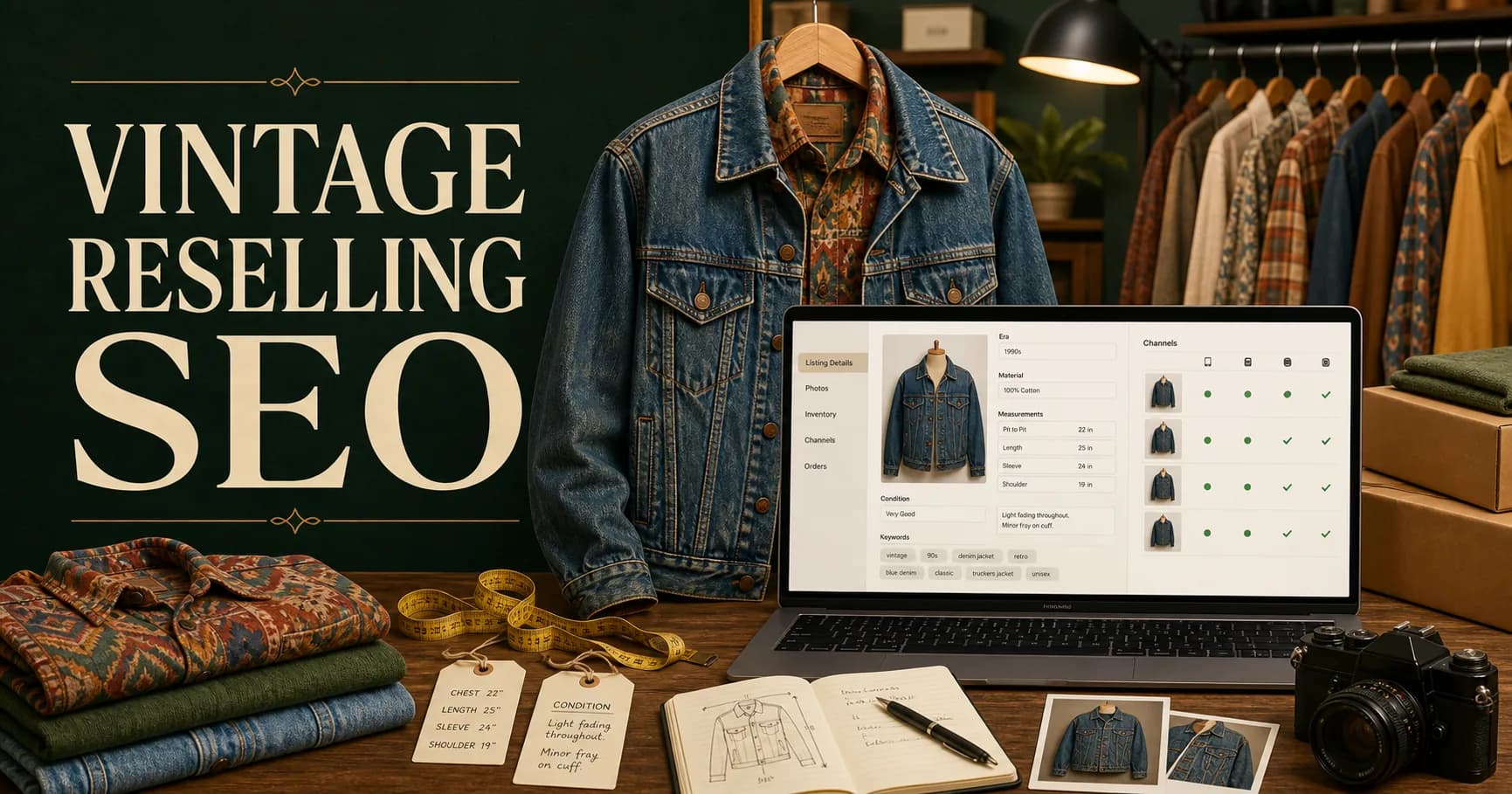
Vintage reselling SEO is the process of documenting a secondhand item accurately, translating its physical details into language buyers use, and adapting that information to the structured fields and search behavior of each marketplace.
It is not a list of fashionable adjectives. A “Y2K,” “90s,” “rare,” or “designer” label should not be added because it attracts attention. Every era, brand, material, size, and condition claim must be supported by the garment or reliable research.
Etsy, eBay, and Depop overlap, but they are not interchangeable. Etsy requires vintage items to be at least 20 years old. eBay relies heavily on category, item specifics, standardized sizing, an 80-character title, listing completeness, price, selling terms, and seller performance. Depop emphasizes accurate descriptions, relevant attributes, original photographs, measurements, condition, pricing, and limited relevant hashtags.
This guide builds one defensible inventory record and then converts it into marketplace-specific listings without creating contradictions or losing control of unique stock.
Key Takeaways
- Call an item vintage only when its age meets the marketplace definition and you can defend the claim.
- Record evidence, measurements, materials, condition, labels, and a unique SKU before writing marketing copy.
- Use one factual product record, then adapt titles, tags, attributes, and descriptions to each platform.
- Treat labeled size and measured size as different facts.
- Photograph the actual item, including labels and every flaw.
- Do not reference a brand unless the item was made by that brand.
- Synchronize unique inventory immediately after a sale.
- Measure profit, returns, and sell-through—not only views or favorites.
What Counts as Vintage in 2026?
“Vintage” has a cultural meaning and a marketplace-policy meaning. Sellers must satisfy the policy of the marketplace they use.
Etsy's current Creativity Standards define vintage products as items that are 20 or more years old and personally curated or collected by the seller. In 2026, that generally means an item produced in 2006 or earlier, but the exact production date still needs evidence. Etsy may request information or photographs concerning the source, age, designer, or materials.
Depop's 2026 Top Seller guidance also says sellers should use “vintage” only for items more than 20 years old and should describe newer products as a decade-inspired style rather than genuine vintage. A new garment with a 1990s-style print is not a 1990s vintage garment.
eBay allows vintage and secondhand inventory across many categories, but all title, condition, item-specific, catalog, and description claims must be accurate.
| Claim | Evidence to record |
|---|---|
| Decade or year | Care label format, union label, date code, catalog, model history, provenance |
| Brand | Original sewn, stamped, printed, or engraved brand evidence |
| Material | Fiber label, manufacturer documentation, or cautious qualified description |
| Country of manufacture | Original label or reliable product documentation |
| Designer/authenticity | Identifiers, construction, provenance, authentication where appropriate |
| Deadstock or unworn | Condition evidence, original tags, storage history; avoid certainty without proof |
Read Etsy's Creativity Standards and Depop's current seller rules before sourcing inventory around a particular platform.
Build a Vintage Item Evidence Record
Create the product record before the listing. For every unique item, assign a SKU and capture:
- Internal SKU and storage location
- Item type
- Verified brand
- Label photographs
- Estimated production year or range
- Evidence supporting the estimate
- Labeled size
- Standardized marketplace size
- Actual measurements
- Material and lining
- Construction details
- Color and pattern
- Condition grade
- Individual flaws
- Repairs or alterations
- Included accessories
- Purchase cost
- Cleaning and repair cost
- Weight and packed dimensions
- Marketplace publication status
Use qualified language when certainty is limited. “Likely late 1990s based on the care label and construction” is more credible than claiming an exact year without documentation.
Create a Defensible Era Vocabulary
Era keywords help buyers, but they must describe the actual item.
| Era | Useful factual signals | Example language |
|---|---|---|
| 1950s | Silhouette, textile, zipper, label, construction, provenance | 1950s fit-and-flare cotton dress |
| 1960s | Mod shape, print, synthetic development, label style | 1960s geometric shift dress |
| 1970s | Flared cuts, prairie construction, disco textiles, label evidence | 1970s high-rise flare trousers |
| 1980s | Shoulder construction, washes, sportswear labels, date evidence | 1980s acid-wash denim jacket |
| 1990s | Single-stitch details, era labels, silhouettes, dated merchandise | 1990s single-stitch graphic T-shirt |
| Early 2000s | Date codes, contemporary labels, low-rise silhouettes, provenance | 2003 low-rise bootcut jeans |
“Y2K” is often used as an aesthetic phrase rather than a production date. Distinguish early-2000s vintage from Y2K-style newer fashion. The first is an age claim; the second is a style description.
Build Keywords From Product Facts
Use a layered vocabulary rather than repeating one fashionable phrase.
| Layer | Questions | Examples |
|---|---|---|
| Product | What is it? | denim jacket, slip dress, bowling shirt |
| Era | When was it made? | 1970s, 1990s, early 2000s |
| Brand | Who made it? | verified label only |
| Material | What is it made from? | wool, rayon, cotton denim |
| Cut/fit | How is it shaped? | cropped, high rise, boxy, bias cut |
| Style | Which accurate aesthetic applies? | western, mod, prairie, workwear |
| Detail | What distinguishes it? | pearl snaps, embroidery, single stitch |
| Color/pattern | What does it look like? | indigo, tartan, floral, geometric |
| Size | What labeled and measured size applies? | label M, 22-inch pit-to-pit |
| Condition | What should the buyer know? | repaired cuff, faded wash, deadstock with tags |
Prioritize product identity over vague buyer phrases. “1990s faded black single-stitch music T-shirt size XL” helps a more qualified buyer than “rare aesthetic vintage top gift.”
Measure Vintage Clothing Consistently
Vintage size labels do not map reliably to current sizing. Washing, alteration, regional standards, brand changes, and historical grading can all affect fit.
Record the label and the physical measurements. Do not replace the original label size with a guessed modern size without explanation.
Tops and jackets
- Pit to pit with garment laid flat
- Shoulder seam to shoulder seam
- Back length from collar seam
- Sleeve from shoulder seam
- Sleeve from center back when construction requires it
- Hem width
Dresses
- Bust
- Waist
- Hip
- Shoulder
- Sleeve
- Total length
- Sweep when relevant
Trousers and jeans
- Waist laid flat and doubled
- Front rise
- Back rise
- Hip
- Thigh
- Inseam
- Leg opening
Shoes
- Marked size and regional system
- Insole length where measurable
- Outsole length and width
- Heel height
State whether a measurement is flat, doubled, approximate, stretched, or unstretched. Include both inches and centimeters when serving international buyers.
This is especially important in August 2026: eBay's current listing guidance says apparel and footwear are moving to standardized sizing, and listings with missing or unclear size values may be hidden until corrected. Review the active category rather than using “See description” as the size field. See eBay's creating-a-listing guidance.
Grade and Describe Condition Without Hiding Flaws
Create an internal grading system, but always provide specific condition details because grades vary between sellers.
| Internal grade | Suggested meaning |
|---|---|
| Excellent | Very limited wear; no material flaw found after inspection |
| Very good | Normal light wear with minor disclosed issues |
| Good | Visible wear or repair, fully disclosed and reflected in price |
| Fair | Significant wear, flaw, alteration, or restoration required |
| For repair | Sold as a restoration, parts, study, or upcycling item where permitted |
Inspect under bright light. Check seams, underarms, cuffs, collar, closures, lining, pockets, hems, stress points, moth damage, stains, odor, dry rot, elastic, print cracking, alterations, and missing hardware.
Describe the location and approximate size of each issue, then photograph it. “Small mark” is weaker than “6 mm pale mark on the left cuff; visible in photo 8.” Do not use lighting or editing to conceal damage.
Photograph the Real Item
Vintage buyers need evidence. Use original photographs showing the actual product.
A useful image sequence includes:
- 1Complete front
- 2Complete back
- 3Side or silhouette
- 4Brand label
- 5Care/material label
- 6Construction or era clue
- 7Important detail
- 8Measurement demonstration
- 9Every flaw
- 10Included accessories
Etsy requires real final-product media for qualifying handpicked vintage products. Depop says sellers must use original photos rather than stock imagery and should show faults. eBay recommends multiple images, labels, details, and imperfections.
Keep color accurate and disclose when screens may vary. Use a consistent background, but avoid removing the context needed to understand texture, scale or transparency.
Adapt the Listing for Etsy
Etsy is suitable only when the item meets its vintage eligibility rules. Its current search guidance evaluates title, tags, categories, attributes, descriptions, first photo, reviews, listing quality and service.
For Etsy:
- Confirm the item is 20+ years old
- Select the most specific category
- Complete every accurate attribute
- Write a short, buyer-friendly title
- Use all 13 relevant tag slots
- Explain age evidence, materials, measurements and condition
- Use photographs of the real item
- Maintain accurate processing and delivery information
Example title:
1990s Faded Black Denim Jacket: Boxy Unisex Medium
Possible tag groups include product, era, cut, material, color, verified style, wearer-neutral fit, and credible occasion. Do not repeat “vintage denim jacket” in most slots.
Continue with the complete Etsy listing SEO guide.
Adapt the Listing for eBay
eBay's Best Match system considers relevance, price, listing completeness and quality, selling terms, and seller history.
For eBay:
- Use an accurate category
- Complete Required and relevant Recommended item specifics
- Use standardized size values and add measurements in the description
- Use up to 80 relevant title characters
- Add exact product identifiers only when applicable
- Select and explain condition consistently
- Compare genuinely similar sold products
- Make shipping, handling and returns competitive and achievable
Example title:
1990s Black Denim Trucker Jacket Unisex Size M 22in Pit to Pit Faded
eBay buyers frequently filter with structured fields. A keyword in the description cannot compensate for a missing size, brand, color, material, style or department specific.
Use our eBay listing SEO and Best Match guide for the complete workflow.
Adapt the Listing for Depop
Depop's official guidance recommends a clear, accurate, concise description; measurements and fit notes; condition and wear; complete category, brand, color and style fields; relevant words and hashtags; competitive pricing; and original photographs.
For Depop:
- Start the description with the actual item and its strongest factual traits
- Add exact measurements and fit notes
- Select the correct category and subcategory
- Use the actual labeled brand only
- Complete color and style attributes accurately
- Describe every flaw
- Use original photos
- Use no more than five relevant hashtags in the listing flow
- Avoid unrelated brands or keyword spam
Example opening:
Authentic late-1990s faded black denim trucker jacket with a boxy fit. Label size M; measures 22 inches pit to pit and 25 inches long. Light cuff fraying shown in photo 7.
Depop warns that irrelevant brands or excess information can harm exposure. Its description guidance prioritizes completeness, clarity, relevant tags and accurate item information.
Continue with our detailed Depop vintage fashion selling guide for photography, pricing, shipping, shop consistency and listing examples.
Platform Comparison
| Element | Etsy | eBay | Depop |
|---|---|---|---|
| Vintage threshold | 20+ years | Accurate claim required; category varies | Current seller guidance uses more than 20 years |
| Title approach | Clear, buyer-friendly | Up to 80 relevant characters | Clear opening in description/listing |
| Structured discovery | Category and attributes | Category and item specifics | Category, brand, color, style and other attributes |
| Keyword expansion | Up to 13 tags | Title, specifics and description | Relevant description, tags and up to five hashtags |
| Images | Real final vintage product | Actual item and flaws | Original photos; no stock images |
| Sizing | Attributes plus measurements | Standardized size plus measurements | Size, measurements and fit notes |
| Strongest operational risk | Ineligible vintage/reselling claim | Missing specifics or poor fulfillment | Misleading brand/hashtags or inaccurate photos |
Create Marketplace-Specific Titles From One Record
Do not copy identical text blindly. Preserve the facts but format them for the platform.
Base record:
- 1990s
- Unbranded
- Black cotton denim
- Trucker jacket
- Label M
- 22-inch pit-to-pit
- Boxy unisex fit
- Fading and small cuff fray
Etsy title:
1990s Faded Black Denim Jacket: Boxy Unisex Medium
eBay title:
1990s Black Denim Trucker Jacket Unisex M 22in Pit to Pit Faded
Depop opening:
Late-1990s black cotton denim trucker jacket with a boxy unisex fit. Label M; 22-inch pit-to-pit measurement.
The language changes, but the age, color, material, size and condition remain consistent.
Price Vintage Inventory From Evidence
Do not price only from one active listing with an ambitious asking price. Compare sold transactions, condition, measurements, brand, rarity, era evidence, included accessories, location and season.
Calculate true item cost:
Purchase + sourcing travel allocation + cleaning + repair + photography + storage + packaging + marketplace fees + payment fees + advertising + expected returns
Then set:
- Minimum profitable price
- Standard list price
- Acceptable offer floor
- Markdown schedule
- Channel-specific price when fees and shipping differ
Higher views do not make an item profitable. Track gross margin and inventory age alongside marketplace engagement.
Synchronize Unique Inventory Across Channels
Most vintage products are one-of-one. A sale on one marketplace must remove the product from every other channel quickly.
Use a centralized record with:
- SKU
- Storage bin or rail position
- Marketplace listing IDs
- Status by channel
- Listed date
- Price by channel
- Offer floor
- Sold channel
- Sold timestamp
- Fulfillment status
Do not rely on memory. A cancellation caused by double-selling damages customer trust and seller performance.
If a cross-listing tool is used, verify its deletion and synchronization behavior before depending on it. Maintain a manual emergency process for failed webhooks or marketplace outages.
A Weekly Vintage SEO Workflow
Intake day
Assign SKUs, photograph labels, research age, measure items, grade condition, calculate cost and decide marketplace eligibility.
Listing day
Create the factual record first. Publish adapted Etsy, eBay and Depop versions only on eligible channels. Verify image order, size fields, attributes, shipping and inventory links.
Review day
Examine impressions, visits, watchers/favorites, offers, sales, returns, questions and margin. Identify whether the problem is discovery, click-through, conversion, price, product demand or seasonality.
Inventory-control day
Reconcile physical stock with every active listing. Remove sold, missing, damaged or reserved inventory. Review listings affected by updated size or attribute requirements.
Common Vintage Reselling SEO Mistakes
- Calling a newer reproduction vintage
- Guessing an exact decade without evidence
- Referencing a brand not shown on the item
- Hiding flaws behind vague condition grades
- Publishing only the label size
- Omitting flat measurements
- Copying the same title and description to every platform
- Repeating aesthetic keywords without product terms
- Using stock photographs
- Describing all faded wear as a desirable “patina”
- Pricing from active listings rather than sold evidence
- Cross-listing without inventory synchronization
- Ignoring marketplace policy changes
- Measuring views without sell-through and margin
Vintage Listing Checklist
- Item eligibility is confirmed for each marketplace.
- Vintage age is supported by recorded evidence.
- Brand claims match the original item.
- Materials are documented or carefully qualified.
- Labeled size is recorded.
- Standardized marketplace size is selected accurately.
- Flat measurements are included.
- Condition inspection is complete.
- Every flaw is described and photographed.
- Category and attributes/item specifics are complete.
- Marketplace titles use accurate buyer language.
- Etsy tags or Depop hashtags are relevant and non-repetitive.
- Images are original and show the actual product.
- Price is based on comparable sold evidence and cost.
- Shipping and returns are accurate.
- SKU and storage location are recorded.
- Cross-channel listings are linked to one inventory record.
- Sale synchronization has a tested fallback.
- Performance is reviewed by listing, channel and margin.
Frequently Asked Questions
How old must an item be to count as vintage?
Etsy requires vintage items to be at least 20 years old. Depop's 2026 Top Seller guidance says more than 20 years old. eBay requires truthful descriptions but category-specific rules differ. Always verify the current marketplace policy.
Can I call a new garment Y2K vintage?
No. A newly manufactured garment can be described as Y2K-style when accurate, but it should not be presented as an original early-2000s vintage item. Style and production age are different claims.
Should I use the label size or modern size?
Record the original label size and provide actual measurements. Select the closest accurate standardized marketplace value where required, but explain the label and fit rather than silently replacing it with a guess.
Can I use a famous brand name to describe a similar style?
No. Use a brand only when the item was genuinely manufactured by that brand. Irrelevant brand references can mislead buyers, violate marketplace rules and reduce listing exposure.
Should I use the same listing text on Etsy, eBay and Depop?
Use the same verified facts, but adapt the structure. Etsy uses categories, attributes and 13 tags; eBay emphasizes an 80-character title and item specifics; Depop emphasizes concise descriptions, attributes and limited relevant hashtags.
How should I describe a flaw?
Name the flaw, location, approximate size and effect on use, then show it in a numbered photograph. Avoid vague language such as “minor wear” when a more precise description is possible.
Is cross-listing duplicate content a Google SEO problem?
Inventory accuracy and marketplace fit are the immediate priorities. Each marketplace controls its own canonical and indexing behavior. Adapt content for buyer clarity and platform fields rather than mechanically duplicating text, and maintain a separate authoritative product page only when your inventory system can keep it accurate.
Which marketplace is best for vintage clothing?
There is no universal winner. The answer depends on item age, product category, target buyer, location, fees, shipping, seller history and marketplace demand. Test eligible inventory by category while measuring net margin and operational workload.
Final Recommendation
Build the evidence record before the marketing copy. Accurate age, brand, measurements, condition, photographs and inventory data create the foundation for discovery and trust on every marketplace. Then adapt those facts to Etsy, eBay and Depop instead of forcing one generic “SEO” listing everywhere.
If you want help applying this to your catalog, you can send a project inquiry to discuss the scope.
Sources and Review Date
This guide was reviewed on 21 August 2026 using current Etsy, eBay and Depop documentation. Marketplace policies and structured fields change, so confirm the active listing interface before bulk updates.
Related posts

Product Page SEO Services Guide for E-commerce Brands
A practical guide to product page SEO services for Shopify, WooCommerce and marketplace-connected stores.
Read article →

Magento Migration Guide: Moving to Shopify or WooCommerce
A practical guide for Magento Open Source and Adobe Commerce merchants: support lifecycle triggers, Shopify vs WooCommerce vs staying, data inventory, redirect mapping at scale, and a cutover checklist.
Read article →

Wix or Squarespace to WordPress: An SEO-Safe Migration Guide
When leaving Wix or Squarespace for WordPress is worth it, what each platform actually lets you export, how to rebuild and redirect every URL, and how to monitor the move in Search Console.
Read article →
Author
Anushka Dahanayake
Anushka Dahanayake builds SEO-focused websites, e-commerce platforms, dashboards, and automation systems for businesses worldwide.