
Etsy Listing SEO: A Practical 2026 Guide for Sellers
A practical Etsy listing SEO guide covering buyer-friendly titles, all 13 tags, categories, attributes, descriptions, photos, conversion, and testing.
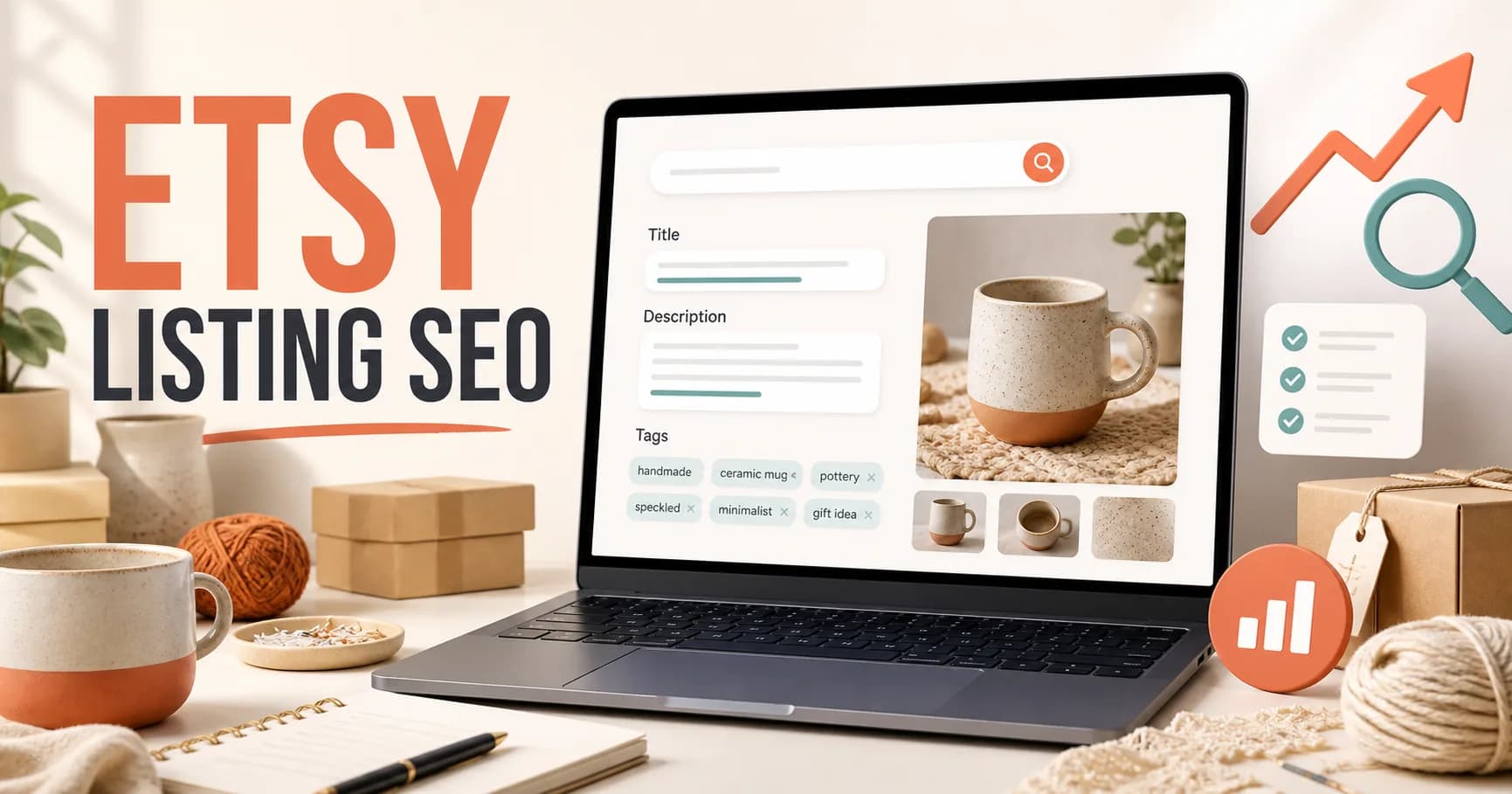
Etsy listing SEO is the process of making a product listing easier for the right shopper to discover, understand, and trust. It is not a trick for repeating keywords. Etsy's current search guidance describes a holistic system that considers the title, tags, categories, attributes, description, first photo, reviews, listing quality, and customer-service signals.
That means a strong listing has two jobs. First, it must give Etsy accurate information for query matching. Second, it must persuade a qualified shopper to click and buy. A title full of repeated search phrases can match words but still lose the sale if it is difficult to scan. A beautiful listing can convert well but remain hard to discover if its category, attributes, and tags are incomplete.
This guide gives handmade, vintage, and craft-supply sellers a repeatable workflow for improving both sides of Etsy search. It reflects Etsy's published guidance available in August 2026, including the platform's April 2026 recommendation to use clearer, buyer-friendly titles.
Key Takeaways
- Treat Etsy SEO as query matching plus ranking and conversion—not keyword density.
- Use the most specific accurate category and every relevant attribute before filling tags.
- Use all 13 tag slots with varied, relevant multi-word phrases.
- Write a short, clear title that states the item and its most important objective traits.
- Make the first image understandable at thumbnail size because it influences clicks and buyer confidence.
- Improve customer service, listing accuracy, and conversion instead of repeatedly renewing listings for a temporary effect.
- Change a small group of variables at a time and measure results in Shop Manager.
How Etsy Search Works
Etsy describes search in two broad stages: query matching and ranking. During matching, Etsy gathers listings whose information appears relevant to a shopper's search. During ranking, it orders matching listings using information about the listing and shop so buyers are more likely to see products they may purchase.
The important consequence is that there is no single Etsy SEO field. Etsy says search takes a holistic view of the information supplied across a listing, including titles, tags, categories, attributes, descriptions, the first photo, reviews, and more. The platform also considers listing quality and customer-service information when ranking results.
| Stage | Seller's objective | Important inputs |
|---|---|---|
| Query matching | Help Etsy understand exactly what the item is and which searches it fits | Category, attributes, title, tags, description |
| Search ranking | Demonstrate that the listing and shop create a useful buyer experience | Relevance, listing quality, clicks, purchases, reviews, service standards |
| Conversion | Help a qualified visitor confidently complete the purchase | First photo, full image set, price, description, delivery details, policies |
Etsy does not publish every algorithmic weight, and those weights may change. Optimize the information and buyer experience you control instead of relying on unsupported claims about a secret ranking formula. Etsy's Ultimate Guide to Etsy Search is the best starting point for current platform guidance.
Start With One Buyer and One Product Intent
Before writing a title or tag, define the buyer and the product in plain language. A useful keyword is not merely popular; it accurately describes the item and reflects a search that the product can satisfy.
Use this five-part product brief:
| Question | Example for a ceramic mug |
|---|---|
| What is the item? | Ceramic coffee mug |
| What makes it distinctive? | Speckled glaze, wheel-thrown, 12-ounce capacity |
| Who may want it? | Coffee drinker, pottery collector |
| What use or occasion is genuinely relevant? | Daily coffee, housewarming gift |
| What constraints matter? | Food-safe, dishwasher-safe, made to order |
Do not add an occasion, recipient, material, style, era, or production method unless it is accurate. Broad phrases such as “gift for her” may have demand, but they are usually less precise than phrases describing the actual product. Accurate specificity attracts fewer irrelevant clicks and makes the rest of the listing easier to write.
Etsy Keyword Research Without Guessing
A practical research process combines marketplace language, shop data, customer language, and product facts.
1. Build a factual vocabulary
List the product type, material, color, size, production method, style, subject, function, era, condition, and personalization options. For vintage products, record the defensible decade or era and the evidence used. For craft supplies, include dimensions, quantity, compatibility, and material.
2. Observe Etsy search language
Type a factual product phrase into Etsy search and note relevant suggestions. Suggestions can reveal common wording, but they are ideas—not proof that every phrase has equal volume or will convert for your product.
3. Review Shop Manager data
Use the search terms and listing-level performance available in Shop Manager. Separate queries that produced impressions from queries that produced visits or orders. A phrase that attracts views but no purchases may be too broad, misleading, or poorly supported by the listing.
4. Read buyer questions and reviews
Customers often use clearer language than sellers. Record recurring questions about size, finish, delivery, compatibility, personalization, or use. Add the answers to the description and, when appropriate, use the same accurate language in titles, tags, or attributes.
5. Group phrases by intent
Organize the research into product, attribute, style, use, recipient, and occasion groups. Choose phrases from different groups instead of writing 13 nearly identical tags.
Choose the Most Specific Accurate Category
Categories are not just navigation. Etsy states that categories act like tags and can help listings match relevant searches. A specific subcategory also places the item within the broader categories above it.
Choose what the item actually is, not merely what it could be used for. A ceramic mug should use the most specific mug or drinkware category available rather than a broad home-decor category. A digital wedding invitation should use the appropriate invitation category rather than a generic wedding category.
A more specific category can also unlock more relevant attributes. Etsy periodically changes its category structure, so review important listings when the marketplace announces updates.
Complete Every Relevant Attribute
Attributes describe structured characteristics such as color, material, size, occasion, recipient, dimensions, or jewelry details. Etsy says attributes work with tags and can affect matching in search.
Select every accurate option that Etsy provides. If a color is technically “sage,” choosing the broader green attribute can still help filters and matching, while “sage green” may be useful elsewhere in the listing. Do not select inaccurate attributes merely to appear in more searches.
Because categories and attributes can act like tags, avoid wasting a tag on an exact phrase already covered by a category or attribute when another relevant phrase can broaden matching. Etsy's Keywords 101 explains this relationship directly.
Write a Clear, Buyer-Friendly Etsy Title
Older Etsy advice often encouraged sellers to fill most of the title with keyword variations. Etsy's April 2026 title guidance moves away from that pattern. The platform recommends clearly stating the item, placing important objective traits early, and considering a title shorter than 15 words when that is enough to describe the product.
Use this structure as a starting point:
Item type: primary material, color, size, or defining feature
Examples:
| Weak title | Clearer title |
|---|---|
| Mug, Coffee Mug, Pottery Mug, Ceramic Cup, Gift for Her | Speckled Ceramic Coffee Mug: Wheel-Thrown 12 oz Cup |
| Necklace Gift, Gold Jewelry, Minimal Necklace, Gift for Wife | Personalized Gold Name Necklace: Adjustable Minimal Chain |
| Vintage Shirt, Retro Tee, Band T-Shirt, Gift for Him | 1990s Cotton Tour T-Shirt: Black Single-Stitch Size Large |
Lead with language that makes the product understandable in a crowded result page. Include an occasion or recipient only when it is essential to the item or represents a credible buyer intent. Do not repeat the same noun and adjective in multiple permutations.
Etsy says the position of a phrase within the title does not change ranking, but leading with the clearest description helps shoppers scanning results, especially on mobile. Review Etsy's 2026 listing-title guidance before updating a large catalog.
Use All 13 Etsy Tags Strategically
Etsy permits up to 13 tags per listing, and each tag can be a short descriptive phrase. Etsy recommends using all available tags and a diverse set of relevant phrases.
For the ceramic mug example, a balanced tag set might cover:
| Intent group | Example tags |
|---|---|
| Product | ceramic coffee mug, pottery mug |
| Material/finish | speckled ceramic, glazed pottery |
| Production | wheel thrown mug, handmade drinkware |
| Style | minimalist mug, rustic kitchenware |
| Use | morning coffee cup, tea lover mug |
| Occasion | housewarming gift |
| Recipient | gift for coffee fan |
| Feature | dishwasher safe mug |
The exact phrases must match the real item. Avoid these common mistakes:
- Repeating the same phrase with minor word-order changes
- Using one generic word per tag when a relevant phrase fits
- Adding unrelated trending aesthetics or recipients
- Repeating categories and attributes without adding useful coverage
- Using English and another language mechanically when Etsy already translates listings for the shopper
- Copying a competitor's tags without confirming product relevance
Etsy's tag help page confirms the 13-tag limit and recommends diverse, accurate phrases.
Write a Description That Answers Buying Questions
Etsy says listing descriptions participate in query matching. Use the first few sentences to state what the item is and naturally incorporate the most relevant product language. Do not paste the title or publish a block of comma-separated keywords.
A useful description normally covers:
- Exact item and what is included
- Materials, finish, dimensions, capacity, quantity, or file type
- Handmade, vintage, designed, or sourced status where relevant
- Variations and personalization instructions
- Production or processing time
- Delivery expectations without unsupported guarantees
- Care, installation, compatibility, or download instructions
- Important limitations and natural variations
- Returns, exchanges, or shop-policy direction
Description example
Opening: This wheel-thrown ceramic coffee mug has a warm speckled glaze and a comfortable 12-ounce capacity for daily coffee or tea.
Details: Each mug is formed and glazed by hand, so the placement of speckles and slight variations in shape will differ. The finished mug is approximately 9 cm tall and is food-safe and dishwasher-safe.
Ordering: Choose the available glaze option before adding the mug to your basket. The mug is made to order, and the current processing estimate appears in the delivery section of the listing.
This copy uses important language while helping a buyer make a decision. It does not promise ranking or repeat keywords unnaturally.
Make the First Photo Earn the Click
Etsy explicitly includes the first photo in its holistic view of a listing. The image also affects click-through and conversion because it is the main visual a shopper sees in results.
The first photo should:
- Show the exact product clearly
- Remain understandable as a small thumbnail
- Use enough contrast to separate the product from the background
- Avoid misleading props or crops
- Match the variation the shopper receives
- Leave no uncertainty about quantity when sets or bundles are involved
Use the remaining image positions to answer visual questions: scale, dimensions, reverse side, texture, finish, packaging, personalization, variations, and the item in use. A short video can demonstrate movement, scale, texture, or production when it adds information.
Do not rely on image filenames as an Etsy ranking tactic. Improve what the shopper can see and understand. For Google image visibility, accurate surrounding listing text and a genuinely useful product image are more defensible than keyword-stuffed filenames.
Improve Listing Quality and Conversion
Etsy explains that listing quality can incorporate how shoppers interact with a result, including whether they click, favorite, or purchase after seeing it in search. This does not mean sellers should manufacture engagement. It means relevance and conversion must be improved together.
If a listing receives impressions but few visits, inspect:
- Whether the first image stands out and remains clear at thumbnail size
- Whether the title immediately communicates the item
- Whether the price is credible for the product and market
- Whether delivery information discourages the target buyer
- Whether the listing is appearing for an irrelevant broad query
If a listing receives visits but few orders, inspect:
- Image completeness and consistency
- Description clarity
- Dimensions and compatibility
- Variation and personalization instructions
- Processing and delivery expectations
- Reviews and customer questions
- Total price, including delivery
- Shop policies and trust information
Do not change SEO fields when the real problem is product-market fit, price, photography, availability, or unclear fulfillment.
Customer Service Is Part of Search Visibility
Etsy says customer-service standards contribute to search ranking. Its published guidance references factors such as review rating, message response rate, and case rate, while accurate processing and delivery practices protect buyer experience.
Complete shop policies, realistic processing times, accurate shipping profiles, prompt communication, and consistent order fulfillment are not separate from Etsy SEO. They support the trust signals that help a marketplace recommend products confidently.
Etsy also states that new listings can appear without existing reviews as long as they do not have other listing or shop-quality issues. New sellers should focus on complete, accurate listings and reliable fulfillment rather than assuming they cannot rank without a review history. See Etsy's customer-service and search guidance.
Use the Etsy Search Visibility Page
The Search Visibility page in Shop Manager provides Etsy's own recommendations about listing, shop, and customer-service quality. Use it before paying for a third-party SEO score that cannot access Etsy's internal data.
Create a monthly review routine:
- Check search visibility recommendations
- Review listing-level impressions, visits, orders, and revenue
- Record the search terms associated with important listings
- Identify high-impression listings with weak click-through
- Identify high-visit listings with weak conversion
- Fix accuracy or customer-service warnings first
- Test one focused improvement group at a time
A Measured 30-Day Etsy SEO Workflow
Days 1–3: Establish the baseline
Choose five to ten important listings. Record their title, category, attributes, tags, first photo, price, processing time, impressions, visits, favorites, orders, and revenue for a consistent comparison period.
Days 4–7: Correct classification and relevance
Select the most specific categories, complete accurate attributes, remove irrelevant tags, and build a balanced set of 13 tags. Do not change photography and pricing during the same step unless they are inaccurate.
Days 8–14: Improve clarity
Rewrite titles using Etsy's current buyer-friendly guidance. Improve the opening description and add missing dimensions, materials, production, variation, and fulfillment information.
Days 15–21: Improve visual conversion
Replace weak first photos and complete the supporting image sequence. Confirm that images accurately represent variations, quantities, scale, and finish.
Days 22–30: Observe before changing again
Allow enough time and traffic to observe directional changes. Compare impressions, visits, visit rate, orders, and conversion. Avoid declaring success based on a few views or one order.
Etsy SEO Measurement Table
| Signal | What it can indicate | First question to investigate |
|---|---|---|
| Low impressions | Weak matching, demand, or eligibility | Are category, attributes, title, and tags accurate? |
| Impressions but few visits | Weak result-page appeal or irrelevant matching | Is the first photo clear and is the title understandable? |
| Visits but few favorites/orders | Conversion or product-offer problem | Are price, images, details, trust, and delivery competitive? |
| Favorites but few purchases | Delayed intent, price, availability, or delivery friction | What prevents the buyer from completing the purchase? |
| Orders with weak margin | Commercial problem rather than SEO success | Does the price cover product, labor, fees, packaging, and support? |
Etsy SEO should produce qualified discovery and profitable orders—not vanity views.
Common Etsy SEO Mistakes
- Writing a title for an algorithm instead of a buyer
- Leaving relevant tags unused
- Repeating the same keyword across most tags
- Choosing a broad category when a precise one exists
- Ignoring attributes because the same words appear in the description
- Publishing inaccurate recipient, occasion, material, or vintage claims
- Using a decorative first photo that hides the product
- Changing titles, tags, photos, prices, and delivery settings simultaneously
- Renewing listings repeatedly without fixing relevance or conversion
- Assuming Etsy Ads repair a weak listing
- Measuring shop-wide views without examining listing-level performance
- Following old advice after Etsy publishes newer platform guidance
Etsy Listing SEO Checklist
- The item is eligible under Etsy's current policies.
- The most specific accurate category is selected.
- Every relevant attribute is completed.
- The title clearly states the item and important objective traits.
- The title is readable and avoids repeated keyword variations.
- All 13 tags are used with accurate, varied phrases.
- Tags add coverage beyond categories and attributes.
- The first description sentences explain the item naturally.
- Materials, dimensions, variations, production, and delivery are clear.
- The first photo is accurate and understandable at thumbnail size.
- Supporting images answer scale, detail, variation, and use questions.
- Processing times and shipping profiles are realistic.
- Shop policies and customer-service information are complete.
- A baseline exists before major changes are published.
- Performance is reviewed using impressions, visits, orders, conversion, and margin.
Frequently Asked Questions
How many tags should an Etsy listing use?
Use all 13 available tag slots when you have 13 accurate and relevant phrases. Etsy describes each tag as another opportunity to match a shopper's search. Variety is more useful than repeating the same words in slightly different orders.
Should every keyword appear in both the title and tags?
No. Etsy evaluates information across the whole listing. Use the title for a clear product description and the tags to add relevant coverage. Categories and attributes can also act like tags, so exact repetition in every field wastes opportunities and can make the listing harder to read.
Should Etsy titles use all 140 available characters?
Not automatically. Etsy's April 2026 guidance recommends clear, scannable titles and suggests considering fewer than 15 words when those words communicate the item and its important traits. Accuracy and buyer comprehension matter more than filling every available character.
Does renewing an Etsy listing improve its ranking?
Recency can be one input, but repeatedly renewing a listing does not repair weak relevance, poor photography, unclear delivery, low conversion, or customer-service problems. Invest first in the listing and offer.
How quickly will Etsy SEO changes work?
There is no universal timeline. Results depend on demand, competition, traffic volume, shop history, product appeal, seasonality, and the changes made. Record a baseline, make focused improvements, and allow enough impressions to compare behavior meaningfully.
Do Etsy Ads improve organic ranking?
Do not treat advertising as a direct organic-ranking fix. Ads can create paid exposure and useful commercial data, but the listing still needs accurate relevance and a competitive buyer experience. Evaluate paid and organic performance separately.
Can a new Etsy shop appear in search without reviews?
Yes. Etsy says new listings can still appear without reviews or ratings when there are no other listing or shop-quality problems. Complete listings, policy compliance, accurate fulfillment, and good customer service are the appropriate starting points.
Final Recommendation
Start with the ten listings most important to revenue or strategic growth. Correct categories and attributes first, then improve title and tag clarity, description completeness, photography, fulfillment, and customer-service quality. Measure the complete journey from impressions to profitable orders.
For a broader multichannel strategy, continue with our vintage reselling SEO guide, eBay listing SEO guide, and Depop selling guide.
If you want help applying this to your shop before you change an entire catalog, you can send a project inquiry to discuss the scope.
Sources and Review Date
This guide was reviewed on 21 August 2026 using current Etsy Help and Seller Handbook guidance. Etsy search changes over time, so verify platform-specific recommendations before a major catalog update.
Related posts

Product Page SEO Services Guide for E-commerce Brands
A practical guide to product page SEO services for Shopify, WooCommerce and marketplace-connected stores.
Read article →

Magento Migration Guide: Moving to Shopify or WooCommerce
A practical guide for Magento Open Source and Adobe Commerce merchants: support lifecycle triggers, Shopify vs WooCommerce vs staying, data inventory, redirect mapping at scale, and a cutover checklist.
Read article →

Wix or Squarespace to WordPress: An SEO-Safe Migration Guide
When leaving Wix or Squarespace for WordPress is worth it, what each platform actually lets you export, how to rebuild and redirect every URL, and how to monitor the move in Search Console.
Read article →
Author
Anushka Dahanayake
Anushka Dahanayake builds SEO-focused websites, e-commerce platforms, dashboards, and automation systems for businesses worldwide.