
Merchant Account and Payment Setup Guide
A practical guide to preparing merchant accounts, payment gateways and checkout settings for international online selling.
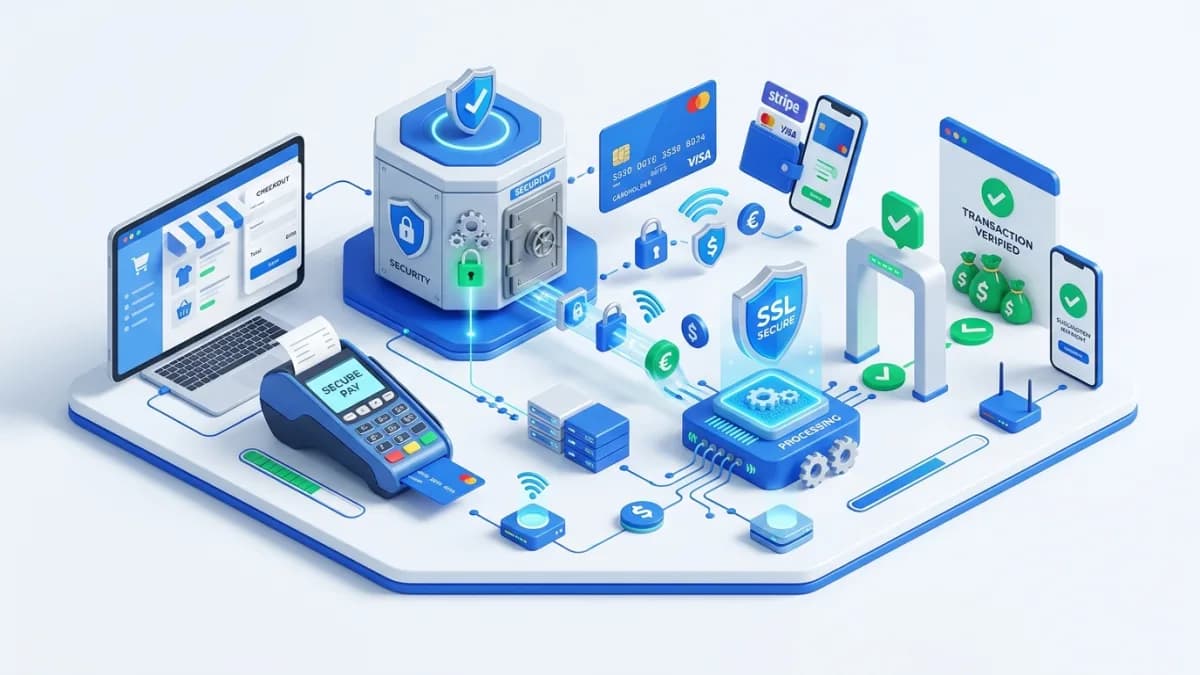
Payment setup is complete only when suitable customers can pay, the store records the correct order state, and the business can reconcile the resulting funds. Installing a gateway and seeing its logo at checkout covers only a small part of that lifecycle.
Review provider eligibility, account information, checkout configuration, and payment workflows. For a new store, payment configuration and testing are part of a scoped E-commerce Website Development build. Approval and available features remain subject to the provider's requirements; setup work cannot guarantee acceptance or bypass verification.
Separate the Roles in the Payment System
A gateway connects the checkout to payment processing. Providers may combine several roles in one service, while other arrangements involve separate acquiring, processing, and merchant-account relationships. Understand the actual arrangement offered to your business.
Distinguish accepting a payment from receiving a payout. A successful customer transaction may enter a provider balance before funds reach the bank. Settlement timing, reserves, disputes, and currency conversion can affect cash availability.
Write a simple flow for the chosen setup: customer action, provider confirmation, order status, fulfillment release, provider balance, and bank reconciliation. This exposes questions that a checkout screenshot cannot answer.
Check Eligibility Before Building Around a Provider
Verify the business's legal country, entity type, product category, bank account, and required documentation against the provider's current requirements. Customer location and merchant eligibility are different questions.
Stripe's global availability page is one example of an official source for checking supported merchant locations. Consult the actual provider and account terms for your situation. Do not assume that selling to customers in a supported country makes a business elsewhere eligible.
Use accurate business information. Borrowed accounts, fabricated addresses, and misleading activity descriptions create serious operational problems and can interrupt access to funds. If the proposed setup does not fit the business, evaluate legitimate alternatives.
Check whether the provider supports the store platform and the payment features required. Recurring billing, delayed capture, local methods, partial refunds, and multiple currencies may depend on the integration as well as the provider.
Prepare a Coherent Verification Pack
Gather the documents and business information requested through the provider's approved process. Typical areas include identity, business registration, ownership, bank details, and a clear description of products and fulfillment.
Make the website consistent with the application. Customers and reviewers should be able to understand what is sold, how to contact the business, and the relevant delivery and refund conditions. Vague product descriptions can create both buyer confusion and account-review questions.
Keep sensitive documents in appropriate secure channels. Do not distribute identity files through a general project chat simply because several contributors are helping with setup. Limit access to those who need it for the approved process.
Record who owns the account, who can issue refunds, and who can change bank details. The merchant should retain control, with suitable access assigned to developers and support staff.
Decide How Currencies Will Work
Distinguish the currency displayed to customers, the currency charged, and the currency paid out to the business. These can differ, and conversion costs may arise at different stages.
For an illustrative store displaying prices in dollars while receiving payouts in another currency, document where conversion occurs and what the customer sees before confirming payment. Avoid implying that the displayed estimate is the final card statement amount when that is not established.
Check refunds and reporting across currencies too. A refunded amount, provider fee, and bank settlement may not combine into a simple one-to-one figure. Finance staff need a reconciliation process that reflects the actual provider reports.
Do not copy generic fee percentages into the launch budget. Use current account pricing and relevant method, currency, and cross-border conditions.
Map Payment States to Order Actions
Define what the store does when payment is pending, requires additional action, succeeds, fails, is cancelled, or is refunded. Fulfillment should follow verified payment and business rules, not merely a customer's return to a thank-you page.
Stripe's payment-status documentation explains why asynchronous status handling matters. Customers can leave the browser or encounter delayed payment methods, so the integration needs a dependable server-side confirmation process appropriate to the provider.
Ask how repeated notifications and retries are handled. The same confirmation arriving twice should not create two shipments. A failed notification should be recoverable through an auditable process.
Keep an internal order reference linked to provider transaction identifiers. This allows support and finance to investigate a payment without asking the customer for sensitive card information.
Test More Than the Happy Path
Test successful payment, decline, authentication interruption, cancellation at the provider, and a delayed or pending method where supported. Confirm that the customer can understand the outcome and retry appropriately.
If you sell to customers in the EU, EEA or UK, include authentication in every card test. Strong Customer Authentication rules under PSD2 (and the UK equivalent) mean many online card payments are challenged through 3-D Secure 2, so the integration must handle the "requires action" state and a failed or abandoned challenge without losing the order. Stripe's Strong Customer Authentication guide summarises the requirement.
Inspect mobile wallets and redirect methods separately. Their experience can differ from ordinary card entry. Check selected variants, shipping, discounts, totals, and the return destination.
Use provider test environments for supported simulations. A test transaction validates particular application behavior, but does not establish that live payouts or every real-world issuer response will work. Plan any authorized live verification with awareness of applicable fees and refund behavior.
The e-commerce analytics guide helps distinguish successful payment records from analytics events. Marketing reports should not be the source of truth for whether money was collected.
Design Refund and Dispute Handling
Define who can approve and issue full or partial refunds, how customers are notified, and how inventory is handled. Refunding a damaged item does not mean it should return to sellable stock.
Stripe's refund documentation describes provider-specific behavior and limitations. Review the equivalent guidance for the selected gateway, including how refund status and timing are communicated. Do not promise an instant bank reversal unless that timing is supported.
Prepare a process for disputes and requests for evidence. Retain appropriate order, delivery, and customer-service records under the business's policies. Access should be limited, and staff should know how to respond within the provider's stated process.
Reconcile Payouts With Orders
Match provider transactions, refunds, fees, adjustments, and payouts to the bank and order system. A payout usually represents a group of financial movements rather than one order.
Document timezone and reporting cutoffs. An order near midnight may appear in a different reporting day from its provider transaction or bank movement. This should not be mistaken for missing revenue without investigation.
For complex reporting requirements, the dashboard data-governance guide explains why definitions and source ownership matter before charts are built.
Prepare an Operational Handover
Keep a configuration record, access-owner list, test evidence, payment-state map, refund procedure, and escalation contacts. Record how secrets are stored and rotated without placing live credentials inside the handover document.
Review the setup after changes to checkout, products, markets, or payment integrations. A previously working flow can change when a new subscription, currency, or shipping destination is introduced.
Frequently Asked Questions
Does gateway installation guarantee merchant approval?
No. Technical compatibility and provider approval are separate. Complete the provider's verification process with accurate information before relying on the account for launch.
Is the confirmation page enough to release an order?
The release rule should use verified payment state and the business's fulfillment requirements. A browser redirect alone is not a dependable confirmation for every payment method.
Should every available payment method be enabled?
Choose methods relevant to customers and supported by the business's refund, reporting, and fulfillment processes. Each additional method needs testing and operational ownership.
Related posts

Business Email Compromise and Invoice Fraud: How Small Businesses Stop It
A defensive guide to business email compromise and invoice fraud for small businesses: how the scams work at a high level, the red flags, the payment and email controls that stop them, and what to do in the first hours after a fraudulent transfer in the US, UK and EU.
Read article →

Passkeys and MFA for Small Teams: What to Choose and How to Roll It Out
A practical guide to multi-factor authentication for small businesses: SMS codes vs authenticator apps vs passkeys and security keys, which accounts to protect first, how to avoid lockouts with recovery codes and backup methods, and a phased rollout plan for a small team.
Read article →

Shopify vs WooCommerce Checkout Comparison
A practical checkout comparison for store owners choosing between Shopify and WooCommerce.
Read article →
Author
Anushka Dahanayake
Anushka Dahanayake builds SEO-focused websites, e-commerce platforms, dashboards, and automation systems for businesses worldwide.