
Portfolio Website Conversion Guide
A practical guide to making portfolio websites better at generating inquiries.

A portfolio should help a prospective client recognize relevant capability and decide whether to start a conversation. Beautiful work can attract attention, but attention alone does not explain what you contributed, which problems you can solve or what kind of project you are accepting now.
Improving portfolio conversion therefore starts with selection and context. The aim is not to turn every project into an aggressive sales page. It is to make the evidence understandable and connect it to a suitable inquiry path without overstating your role or results.
Define the work you want the portfolio to attract
Write a short description of the projects you want next: the service, client situation, scope and practical constraints. Use that description to decide what belongs in the primary portfolio rather than displaying everything in chronological order.
A hypothetical brand designer moving toward packaging projects may have many older social-media graphics. Those can demonstrate craft, but they should not dominate the first impression if packaging is the intended service.
Keep an archive when older work remains useful, but separate it from the selected projects that explain current positioning. Curation is not hiding your history; it is helping visitors assess the capability relevant to their decision.
Select projects for evidence, not just appearance
Choose work that demonstrates the types of constraints and decisions a future client will care about. A visually restrained project with clear business context may provide stronger evidence than a striking image with no explanation of its purpose.
Consider variety within the intended specialty. For packaging, that might include a product range, a limited production constraint and an information-heavy label. Each project should add a distinct reason to believe you can handle the target work.
Do not use a famous client name as a substitute for context. Explain the actual assignment and your contribution. A small subcontracted task should not be presented as ownership of an entire brand transformation.
Make project previews meaningful
Use a preview title and short description that explain what the visitor will see. Include the project type and relevant role where useful. A grid of mysterious brand names may be attractive but difficult for a buyer to navigate.
Choose a representative image rather than a crop that conceals the actual work. For a website, show a readable view of the interface; for packaging, show the product and important details. Decorative mockups can support the presentation but should not be the only evidence.
Keep preview dimensions stable and make the destination clear. Visitors should not have to guess whether an image opens a gallery, a case study or an external site. Check that keyboard users can reach the same project information.
Give each project a concise factual foundation
Start the detail page with the client context, objective, scope and your role. Identify collaborators where appropriate and distinguish commissioned work from a concept or self-initiated exercise.
For the packaging designer, a useful opening could state that the assignment covered a three-product label system and print-ready artwork, while naming who supplied photography and copy. This prevents visitors from attributing every visible element to one person.
Include the delivery period or publication date when it helps readers interpret the work. Older interfaces and brand assets can remain valid evidence, but they should not be presented as a current live implementation if they have since changed.
Explain a few consequential decisions
Choose two or three decisions that reveal your judgment. Describe the constraint, alternatives considered and reason for the chosen approach. Avoid narrating every routine production step or filling the page with process terminology.
For example, a label hierarchy might separate mandatory product information from the visual system used to distinguish variants. Explain that design problem and show the relevant detail rather than claiming the final result was simply more premium.
Keep the explanation understandable to a buyer. Technical vocabulary can be included when necessary, but define its practical significance. The purpose is to make your contribution evaluable, not to demonstrate how many specialist terms you know.
Present outcomes at the level the evidence supports
Separate delivered outputs, observed operational changes and measured commercial results. A completed design system is a deliverable. Faster internal production is an outcome only if it was observed or measured. Revenue growth requires stronger evidence and careful attribution.
When reliable metrics are unavailable, say what was completed and accepted. Permissioned client feedback can add context, but it should remain accurate and not be edited into a claim the client did not make.
Do not create hypothetical improvement percentages to make a real project seem more convincing. A precise explanation of the problem and the approved solution is more credible than a dramatic result without a source.
Use media to reveal the work
Provide enough image detail to inspect important decisions. Add captions where the significance is not obvious, and keep essential explanation in text. If an image contains a complex interface or diagram, describe the relevant point outside the image as well.
The W3C images tutorial distinguishes informative, decorative and functional image needs. Apply text alternatives according to an image's purpose rather than repeating a keyword across every project screenshot.
Check mobile presentation, loading behavior and enlarged views. Oversized files and awkward horizontal galleries can make the portfolio difficult to evaluate on a phone. A video should have a clear purpose and an accessible way to understand its important content.
Connect projects to your current service offer
After the project explanation, identify the related service and the type of inquiry you welcome. A visitor who recognizes a similar problem should not have to return to the homepage and reconstruct the connection.
For the designer, the next step might be a packaging-project inquiry that asks about product range, production stage and intended launch window. Do not require a detailed creative brief before an initial suitability conversation unless that is genuinely necessary.
Use Portfolio Website Development for the site experience that presents this work. The business website development guide explains how services, evidence and contact routes fit together.
Keep the inquiry path proportionate
Ask for the information needed to assess fit and respond. Explain what happens next without promising availability or a response window that you cannot maintain. Make unsupported project types clear enough to reduce confusion.
Test the actual submission and notification path. A portfolio can receive appreciative visits while losing serious inquiries through a broken form or an outdated email address. Review confirmation messages and mobile field behavior as part of routine maintenance.
The lead management guide is useful when inquiries need structured follow-up. Even a small practice benefits from knowing which project prompted contact and who is responsible for the response.
Review the portfolio as your work changes
Periodically compare displayed projects with the work you are currently seeking. Retire weak or redundant entries, refresh broken external links and update any project whose live implementation has changed substantially.
Review inquiry quality rather than only gallery views. Ask whether prospects understand your role, request relevant work and arrive with realistic expectations. Their questions can reveal missing context that an analytics chart cannot explain.
Keep permissions and source files organized. If a client withdraws publication approval or a collaborator's credit changes, you should be able to update the affected project accurately without searching through years of informal messages.
Frequently Asked Questions
How many projects should be featured?
Use enough strong, relevant examples to demonstrate the intended capability without repeating the same evidence. A smaller curated selection is often easier to assess than a large undifferentiated archive, but there is no universal ideal count.
Can concept work appear in a commercial portfolio?
Yes, when it is clearly labeled as concept or self-initiated work. Explain the brief and your contribution without implying a client commissioned it or that it produced real business results.
Should every project have a long case study?
No. Match the depth to the evidence and complexity. A concise project page can be useful, while a more involved engagement may justify a detailed account of decisions, constraints and verified outcomes.
Related posts

Website Accessibility Basics for Business Owners
A practical website accessibility basics guide for business owners.
Read article →
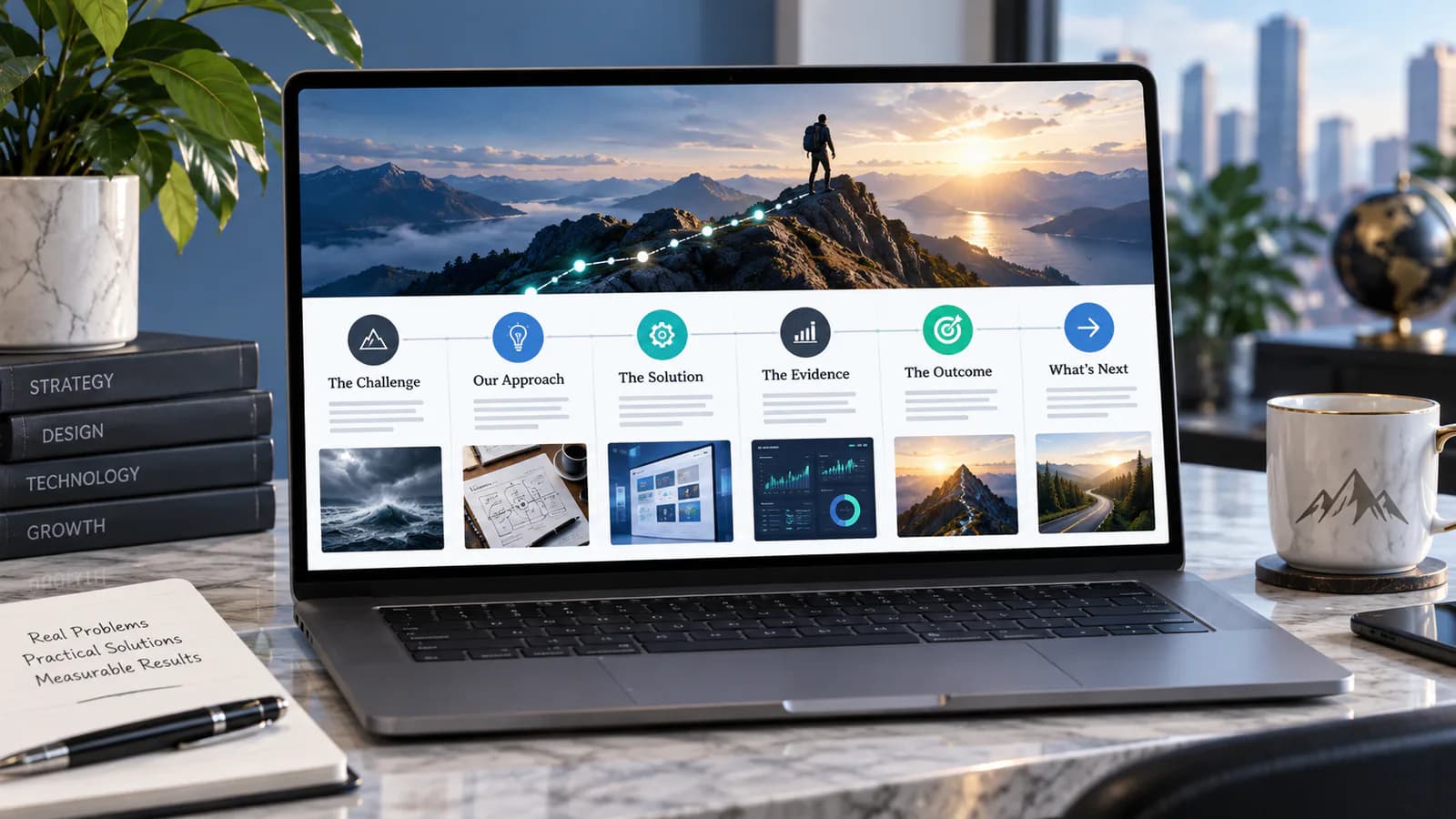
Case Study Page Template for Service Websites
A practical case study page template for service websites that need stronger proof.
Read article →

About Page Strategy Guide for Service Businesses
A practical About page strategy guide for service businesses that want stronger trust.
Read article →
Author
Anushka Dahanayake
Anushka Dahanayake builds SEO-focused websites, e-commerce platforms, dashboards, and automation systems for businesses worldwide.