
Pinterest Paid Ads Guide for E-commerce Stores
A practical Pinterest ads guide for e-commerce brands that want paid product discovery without wasting budget.
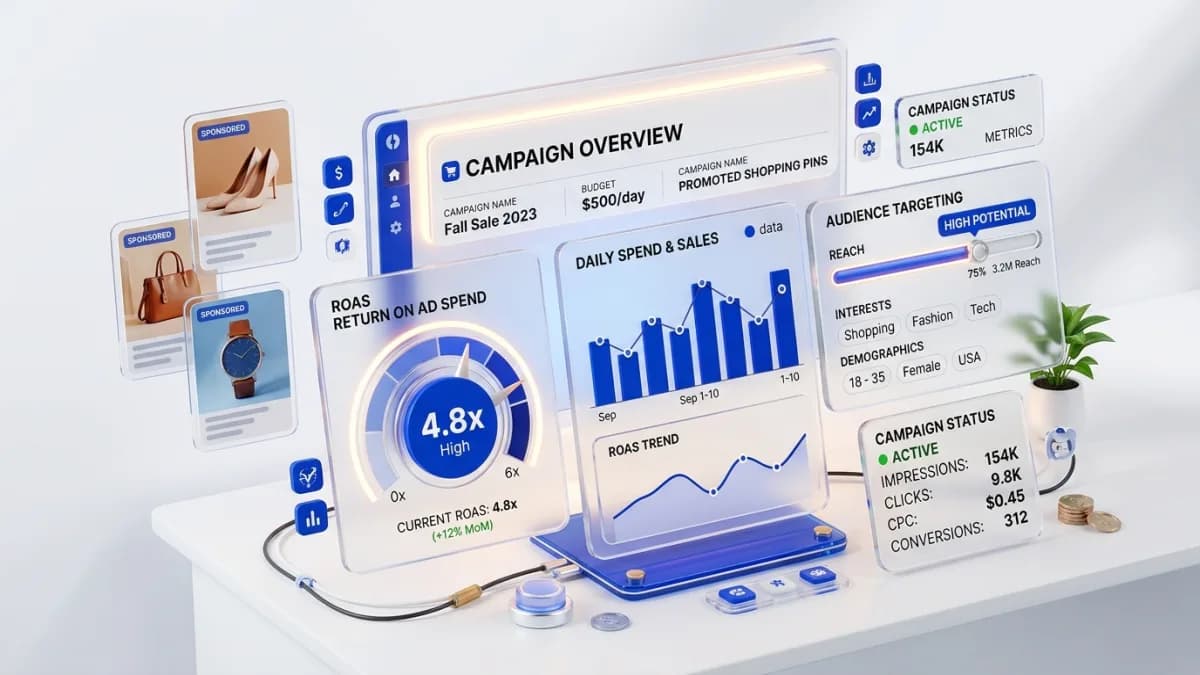
Pinterest paid advertising gives a store a way to distribute product and discovery content beyond its existing audience. The difficult part is deciding what to promote, how much uncertainty the business can afford, and whether the resulting customers are commercially valuable.
A campaign should begin with a prepared product journey and a clear measurement plan. The campaign should connect creative, catalog, landing pages, and reporting rather than treating the advertising interface as the whole project.
Establish the Constraints Before Choosing a Campaign
Confirm advertising access, supported markets, payment arrangements, product eligibility, and available campaign options in the actual business account. Do not build a media plan around features visible only in another region or an outdated tutorial.
List delivery destinations, stock constraints, contribution margins, and creative capacity. These determine which products can support a test. A high-priced product may still be unsuitable if delivery is unreliable or returns consume most of the margin.
Define what the first campaign should teach. You might need to compare two product use cases, assess whether a collection attracts qualified visits, or test purchase acquisition for a proven bestseller. A single campaign cannot answer every market question at once.
Calculate an Affordable Learning Budget
Start with the value of an order after variable costs. Include product cost, packaging, payment charges, shipping subsidy, and a realistic allowance for returns where you have evidence. Keep this calculation separate from gross revenue.
In an illustrative scenario, a 70-unit order leaves 24 units before advertising and overhead. An acquisition cost of 30 is not immediately profitable. It may be justified by repeat purchasing, but only if comparable customer cohorts support that assumption.
Set an overall test limit and identify who can approve changes. The appropriate amount depends on product economics, expected conversion frequency, and the uncertainty being tested. There is no defensible universal daily budget for every store.
Plan for delayed learning. A short test with few purchases may be inconclusive, particularly for considered purchases. Decide in advance what evidence would justify continuing, changing the offer, or stopping. Do not keep spending simply because the campaign has not yet produced the hoped-for result.
Choose Products That Can Carry the Promise
Build product groups around meaningful buying contexts. A home-office collection might separate compact-space storage from decorative desk accessories. These groups call for different creative and may attract different customer expectations.
Inspect product records before promotion. Titles, images, links, prices, availability, and variant grouping must agree with the store. Pinterest's catalog setup guidance explains product data requirements and error handling; use the account's diagnostics to verify your own feed.
Exclude unavailable or operationally risky products from the initial test. If a product has limited remaining stock, determine whether the campaign can be paused promptly when availability changes. Advertising a product customers cannot buy produces misleading click data and wasted effort.
Write Creative Hypotheses Instead of Random Variations
A creative hypothesis explains why a particular presentation might resonate. For a modular shelf, one concept might show storage in a narrow hallway. Another might demonstrate rearranging the modules. These communicate different benefits, not merely different colors of text.
Keep the product recognizable and the claim accurate. Show the configuration associated with the advertised offer, or clearly explain upgrades. Avoid imagery that suggests accessories are included when they are sold separately.
Use a small, interpretable set of concepts. If the team changes the audience, offer, imagery, destination, and bidding approach simultaneously, it becomes difficult to identify what caused a result. Creative testing should produce knowledge that informs the next campaign.
Record asset versions and their destinations. This helps connect performance to the actual message a customer saw. A filename such as final-new-version does not provide a useful history when several people are uploading creative.
Make the Landing Page Fulfill the Ad
Open every promoted destination on a phone. The visible product, price, and availability should match the ad. A collection destination should make the featured products easy to find rather than burying them behind unrelated sorting.
Check delivery information, variant selection, image clarity, and the buying action. A beautifully styled pin can create expectations the product page does not answer. For example, a storage image suggests a particular capacity, so dimensions and practical contents need to be clear.
For deeper merchandising work, the product-page SEO guide explains how product facts, imagery, and page structure fit together. Search optimization and paid-traffic clarity both depend on accurate information.
Validate Events and Their Meaning
Create an event map before evaluating campaign performance. Pinterest's conversion documentation defines Checkout as a completed transaction and separately lists InitiateCheckout. Confusing those events can make a store appear to generate purchases when visitors only began checkout.
Test event values, currency, product identifiers, and transaction references. Confirm that reloading a confirmation page does not create duplicate reported purchases. When browser and server integrations both send an event, verify the platform's current deduplication requirements with the implementer.
Respect consent and the applicable data-sharing requirements of the business. Server-side reporting is not a reason to ignore a customer's choices. Keep unnecessary personal information out of analytics payloads.
For visitors in the EU and UK, an advertising tag such as the Pinterest tag generally needs prior opt-in consent under the ePrivacy rules and PECR before it sets cookies or sends browsing data, and rejecting should be as easy as accepting. Confirm that the tag and any server-side events actually respect the consent banner's state, and expect lower attributed conversions from those markets as a result.
Use the GA4 revenue-validation guide to structure reconciliation with the store. Report known gaps and attribution differences instead of forcing every system to display an identical number.
Read the Funnel Before Making Changes
Impressions show delivery, not commercial success. Outbound clicks indicate a visit opportunity. Product engagement, carts, and orders help explain what happened afterward. Examine these stages together.
If ads receive attention but little outbound activity, investigate the creative promise and audience context. If visits reach the store but customers cannot find the featured item, fix the destination. If carts occur but orders fail, test checkout and delivery conditions.
Do not judge an entire channel from one weak product. At the same time, avoid endlessly changing creative when the economics or offer are unsuitable. The decision should follow evidence about the particular failure point.
Keep Attribution and Profit Separate
Document the attribution windows and interaction types included in the advertising report. View-through and click-through reporting answer different questions, and a platform's attributed sale is not automatically an incremental sale caused solely by that platform.
Compare advertising data with order trends and customer cohorts where feasible. Do not add Pinterest-attributed revenue to revenue claimed by other platforms. Several systems may claim involvement in the same order.
Review refunds and cancellations after sufficient time has passed. A campaign can look attractive immediately after purchase and less attractive after returns. Where sample sizes permit, compare product mix and repeat purchasing rather than focusing only on initial revenue.
Build a Practical Management Rhythm
Monitor delivery failures, broken links, stock errors, and tracking interruptions promptly. Review strategic decisions on a cadence that allows meaningful evidence to accumulate. Constant unplanned changes can make the test hard to interpret.
Maintain a change log covering budgets, audience settings, creative, destinations, and promotions. Assign ownership for pausing products with fulfillment issues. The campaign manager and store operator need a shared way to report problems.
An effective handover should explain what was tested, what the evidence supports, what remains uncertain, and which changes come next. Avoid presenting every increase as a proven causal win.
Frequently Asked Questions
Should we advertise the entire catalog immediately?
Usually a focused selection is easier to evaluate, but the right scope depends on catalog quality and campaign design. Begin with products that have dependable stock, clear destinations, and workable economics, then expand when the evidence supports it.
Is a high return on ad spend enough to scale?
No. Check contribution, attribution assumptions, returns, fulfillment capacity, and whether performance holds as spend changes. A reported ratio is one input to a commercial decision, not a complete explanation of profitability.
Related posts

Passkeys and MFA for Small Teams: What to Choose and How to Roll It Out
A practical guide to multi-factor authentication for small businesses: SMS codes vs authenticator apps vs passkeys and security keys, which accounts to protect first, how to avoid lockouts with recovery codes and backup methods, and a phased rollout plan for a small team.
Read article →

Product Page SEO Services Guide for E-commerce Brands
A practical guide to product page SEO services for Shopify, WooCommerce and marketplace-connected stores.
Read article →

European Accessibility Act for E-Commerce Websites: What Stores Must Do
A practical guide to the European Accessibility Act (Directive (EU) 2019/882) for e-commerce and consumer service websites: who is in scope, the microenterprise exemption, EN 301 549 and WCAG, accessibility information, enforcement and a remediation plan for WooCommerce and Shopify stores.
Read article →
Author
Anushka Dahanayake
Anushka Dahanayake builds SEO-focused websites, e-commerce platforms, dashboards, and automation systems for businesses worldwide.