
Google Business and Local SEO Guide for Service Companies
A practical local SEO guide for service companies that want more qualified calls, bookings and local inquiries.
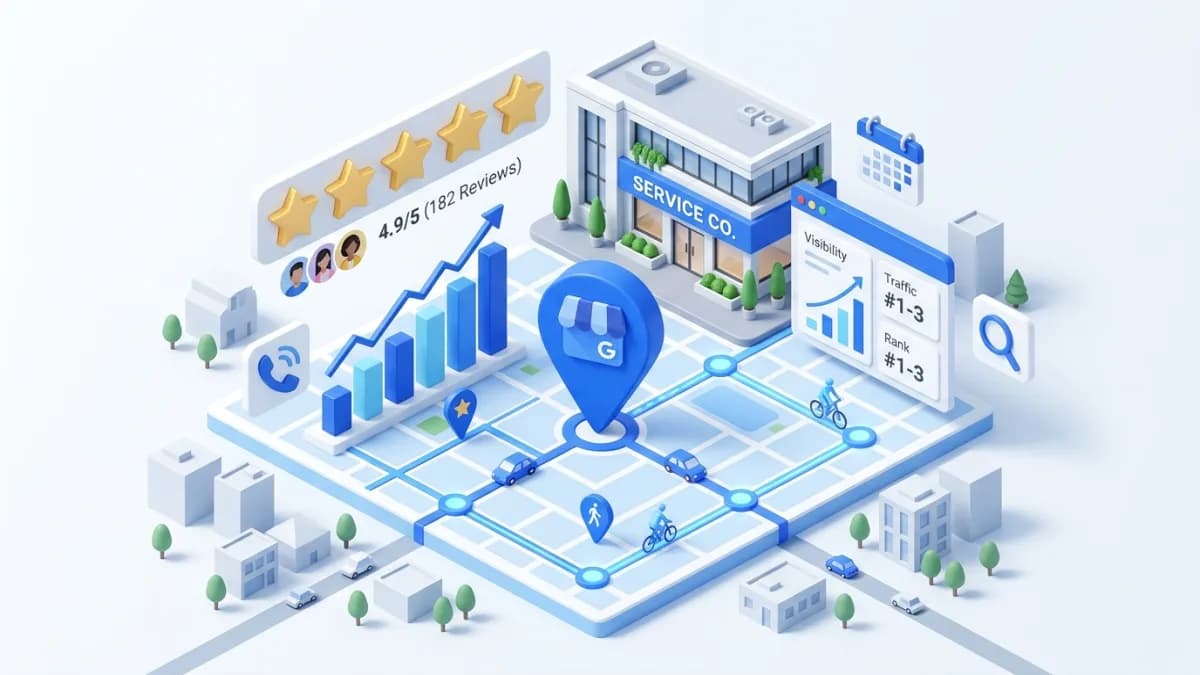
Local search works best when a business's public information reflects how it actually serves customers. A profile, website, directory entry, and booking page should agree about the business identity, services, location or service area, and contact route.
For service companies, Google Business and local SEO work should begin with eligibility and accurate representation, then improve the pages and processes that turn suitable local interest into inquiries. It cannot guarantee a position in Maps or make distance irrelevant.
Confirm Eligibility and Ownership First
Review whether the business qualifies for a Google Business Profile under the current rules. An online-only business and a company that meets customers in person can have different eligibility. Do not assume that having a website or a registered address is sufficient.
Google's business representation guidelines explain location, service-area, naming, and eligibility requirements. Check the provisions relevant to your business model before creating or changing a profile.
Identify the primary owner and authorized managers. The business should retain control of its profile and associated accounts. An agency can help manage the work without becoming the only party capable of restoring access.
Resolve duplicates or ownership issues through the appropriate platform process. Creating additional profiles to escape a problem can make the representation more confusing and create further policy issues.
Represent the Business as Customers Know It
Use the real business name rather than adding a list of services and towns solely for search exposure. Select categories that describe what the business is and does. Keep phone numbers, website links, and hours accurate.
Distinguish a customer-facing location from an address where customers are not received. A service-area business should follow the applicable address-display rules. Do not create fictional offices or use a virtual address to imply a staffed location that does not exist.
Set service areas according to genuine coverage and operational capacity. A wide area on a profile does not establish an ability to rank throughout it, nor does it make a long-distance appointment commercially sensible.
Build Service Pages Around Local Buying Questions
A service page should explain the work offered, who it suits, where it is available, important limitations, and how to request it. Add local details when they affect the actual service rather than repeating a town name throughout generic copy.
For an illustrative appliance-repair company, customers may need to know supported appliance types, diagnostic arrangements, coverage areas, appointment windows, and how parts affect timing. Those details are more useful than repeated claims to be the best repair company in every suburb.
Show credible evidence such as relevant qualifications, team information, genuine project examples, and clear contact details. Obtain permission before using customer names, property photographs, or testimonials. Avoid implying credentials or affiliations the business does not hold.
The multi-location local SEO guide provides additional context for connecting local information with practical inquiry paths.
Decide Whether Separate Location Pages Are Useful
Create a location page when it has a distinct customer purpose and accurate information. A real branch may have its own team, hours, directions, accessibility details, and services. A service-area page may explain genuine local coverage and constraints.
Do not publish dozens of pages that change only the place name. If the business has nothing different or useful to say, a well-organized coverage section may serve customers better.
For the repair-company example, two staffed branches could justify separate pages. Twenty nearly identical suburb pages with invented office details would not. The decision should follow actual operations and customer needs.
Keep navigation understandable. Customers should be able to find the relevant service and location without guessing whether information belongs under branches, areas, or services.
Develop a Consistent Review Process
Ask customers for honest feedback through a neutral process. Avoid incentives, fabricated reviews, or selectively directing only happy customers to a public review channel. The purpose is authentic feedback, not a manufactured rating profile.
Make the request timely and easy to understand. A short message after a completed service can explain where feedback is welcome. Do not pressure customers or make a positive review a condition of support.
Respond professionally to criticism. Acknowledge the concern without revealing private order, health, financial, or personal details. Move sensitive resolution into an appropriate private channel.
Use feedback internally. Repeated comments about late arrivals or unclear pricing indicate an operational issue. Local SEO cannot compensate indefinitely for a service process that creates the same disappointment repeatedly.
Keep Photos, Hours, and Contact Paths Current
Use real images that help customers recognize the location, team, equipment, or work. An exterior image can help someone arrive at the correct entrance. A service demonstration can clarify what the company actually does.
Update special hours and temporary changes promptly. A customer who travels to a closed location experiences an operational failure, even if the website design is excellent. Assign ownership for maintaining this information.
Test profile links, phone actions, booking pages, and contact forms on mobile. Verify that inquiries reach the right person and that the business can respond within the expectation it sets.
If several branches share a central booking team, explain that clearly. The phone and website journey should not imply a local office answers directly when all inquiries follow another process.
Understand What Local Ranking Guidance Actually Says
Google's local ranking help page describes relevance, distance, and prominence, and states that businesses cannot request or pay for a better local ranking. Accurate information and useful customer-facing content support the business's representation, but do not remove those other factors.
Be cautious with reports promising a universal number-one position. Results depend on the searcher's location and query, among other factors. A screenshot from one point does not establish visibility across an entire region.
Measure search visibility as one part of the customer journey. A profile can generate calls that are irrelevant, outside coverage, or unanswered. Qualified inquiries and service capacity matter more than a single ranking graphic.
Coordinate Directories and Website Information
Review important directory entries and business listings for outdated addresses, phone numbers, URLs, and names. Prioritize sources customers actually use and records that materially affect the business's public identity.
Keep a central reference for approved contact details and branch information. When the business moves or changes hours, the team needs a list of places to update. This is easier than reconstructing the footprint during an urgent correction.
Avoid buying large packages of irrelevant directory submissions. The practical value of a listing depends on its accuracy, relevance, and customer use, not merely the number of URLs created.
Measure Inquiries Through to Outcomes
Track calls, form submissions, bookings, and qualified opportunities using consistent definitions. A click on a phone link is not proof that a call connected, and a booking request may still need confirmation.
Connect the website journey to an owned follow-up process. The lead-management workflow guide explains how inquiries need an owner, status, and next action after submission.
Review missed calls, response times, and unsuitable inquiries alongside search data. Improvements to intake can increase the value of existing visibility without changing rankings at all.
Frequently Asked Questions
Can a service-area business rank everywhere it travels?
No. Actual service coverage and search visibility are different. Represent coverage honestly and evaluate results in the context of relevant queries and locations.
Should we add keywords to the business name?
Use the name the business genuinely uses, following Google's current guidelines. Do not add promotional phrases or locations merely to influence search.
What should a local SEO engagement deliver?
Expect an eligibility and accuracy review, useful service and location recommendations, corrected contact journeys, a review-management process, and measurement of qualified inquiries. Guaranteed rankings are not a dependable deliverable.
Related posts

Product Page SEO Services Guide for E-commerce Brands
A practical guide to product page SEO services for Shopify, WooCommerce and marketplace-connected stores.
Read article →
US State Privacy Laws for Small Business Websites: What Applies and What to Do
A practical 2026 guide to US state privacy laws for small business websites: CCPA/CPRA thresholds, the other comprehensive state laws, Texas and Nebraska small-business rules, privacy notices, opt-out of sale and sharing, Global Privacy Control, pixels, forms, vendor contracts and CAN-SPAM.
Read article →

Magento Migration Guide: Moving to Shopify or WooCommerce
A practical guide for Magento Open Source and Adobe Commerce merchants: support lifecycle triggers, Shopify vs WooCommerce vs staying, data inventory, redirect mapping at scale, and a cutover checklist.
Read article →
Author
Anushka Dahanayake
Anushka Dahanayake builds SEO-focused websites, e-commerce platforms, dashboards, and automation systems for businesses worldwide.