
Pinterest Marketing Consultation Guide for Store Owners
A guide for store owners preparing to use Pinterest for product discovery, organic traffic and paid shopping campaigns.
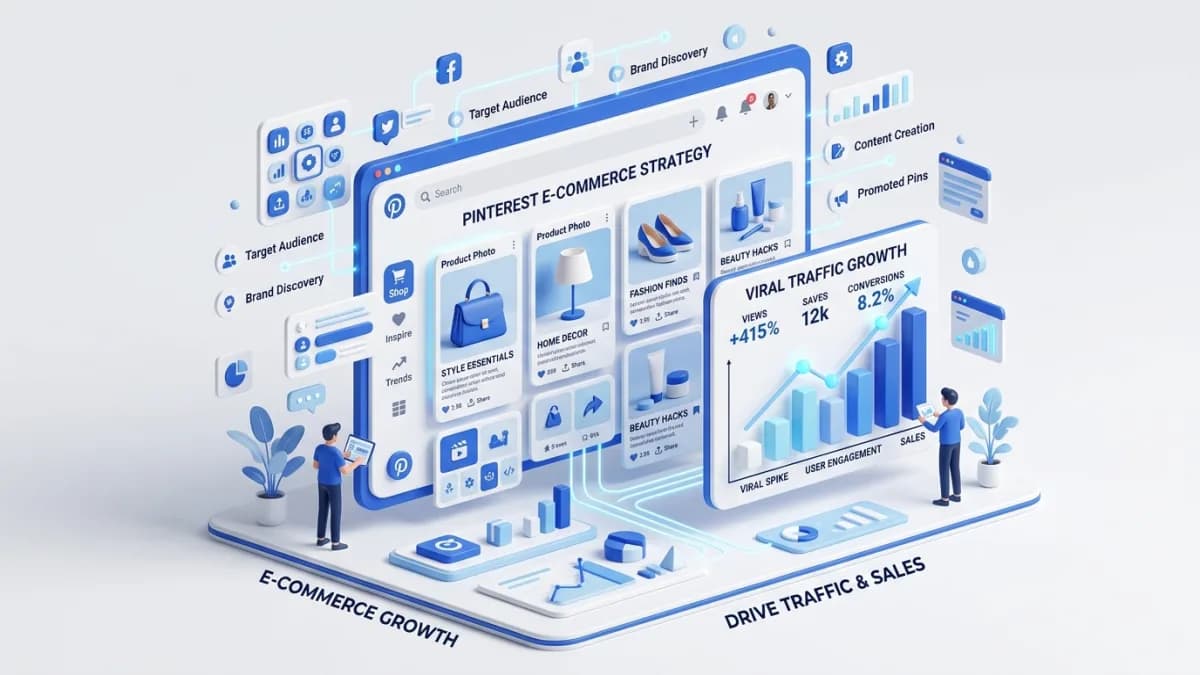
A Pinterest consultation is most valuable when it answers whether the channel fits the store, what needs preparation, and what evidence would justify further investment. Leaving with a list of pin ideas is useful only if the business can turn the resulting attention into a suitable customer journey.
Store owners should arrive with product information, commercial constraints, and specific questions. The consultation can then focus on decisions rather than spending the entire session locating accounts and explaining the catalog.
Decide Which Business Question Needs an Answer
Different starting points require different conversations. A new store may need to assess audience fit. An established merchant may need to understand why existing pins attract saves but few useful visits. Another business may be considering paid distribution and need to review readiness.
Write the question in a sentence. For example: can our modular shelving range support a repeatable stream of useful room-planning content for customers in our delivery area? That question connects products, audience, creative, and fulfillment.
Avoid an undefined objective such as becoming popular on Pinterest. Popularity does not tell the team which products to promote, what content to create, or whether the store can serve the people it attracts. Name the commercial action that matters, while allowing discovery content to play a supporting role.
Assess Product Fit Through Buying Context
Look at how people discover and choose your category. Some purchases begin with visual planning, styling, gifts, projects, or seasonal preparation. Others are urgent replacements where buyers search for an exact model and need immediate availability.
Neither pattern guarantees success or failure. It changes the content approach and the evidence required. A garden retailer might show planting combinations and link to the relevant collection. A replacement-parts seller may need highly specific compatibility content instead of broad lifestyle imagery.
Bring a shortlist of products with reliable stock, understandable benefits, useful images, and workable margins. Exclude products with unresolved quality issues or delivery restrictions that contradict the intended audience. A channel strategy cannot repair those fundamentals by increasing reach.
Compare the shortlist against actual customer questions. If you can explain several meaningful uses without inventing claims, you have material for distinct content. If every idea repeats the same promotional sentence, the creative brief needs more product research.
Prepare an Account and Access Inventory
Record who owns the business account, website, advertising account where applicable, catalog connection, and analytics configuration. Identify whether an agency or former employee controls any essential asset.
Use appropriate access invitations rather than sharing passwords in a consultation document. The merchant should retain ownership of core business accounts. Clarify who can make changes and who is attending only to advise.
Check feature availability for the actual account and operating market before planning around catalogs, ads, or particular formats. Platform features and eligibility differ. The consultant should verify what the business can use instead of relying on a screenshot from another account.
Bring recent performance exports if the account already has activity. Preserve date ranges and metric definitions. A screenshot showing a single impressive number without context is difficult to evaluate and may hide whether the activity was paid or organic.
Review the Catalog Before Discussing Scale
Pinterest's retail catalog documentation describes prerequisites including a business account, website claim, tag installation, and a website meeting merchant guidelines. It also explains that catalog errors can prevent some or all product information from updating.
For the consultation, bring a sample of current product records. Include identifiers, links, images, price, availability, and variant relationships. Ask how those fields reach Pinterest and who investigates failed updates.
A feed is an operational dependency. If a product sells out in the store but remains promoted elsewhere, customers encounter a broken promise. Ask how often information is refreshed, what happens when the connection fails, and whether a manual upload process is realistic for the team's workload.
Do not spend the entire meeting on feed mechanics if the business has not yet established product fit. Separate readiness work from the channel decision so the store does not mistake technical setup for a validated growth strategy.
Connect Pins to the Right Destination
Each creative idea needs a destination that fulfills its promise. A pin showing a particular linen table setting should lead to an available product, a relevant collection, or a useful guide explaining that setting. A generic homepage may leave the shopper searching again.
Inspect the destination on a phone. Is the pictured option selected? Are dimensions, materials, delivery limits, and price clear? Can the buyer compare related items without losing the original product?
For educational content, plan the next step within the article. A room-layout guide could link to appropriately sized shelving, with limitations explained. The link should follow the reader's task naturally rather than appearing as an unrelated sales interruption.
The Pinterest strategy guide for online stores provides broader context for connecting discovery content with a store. Use it to identify which part of that journey your consultation needs to resolve.
Discuss Creative Capacity Honestly
Count the original images and demonstrations the team can produce, not only the graphics it can resize. Identify who photographs products, confirms details, writes copy, and approves publication.
An illustrative homewares store might begin with three content directions: compact dining layouts, material care, and occasion-based table settings. Each direction needs distinct useful information. Repeating the same product photograph with a new adjective is not a substantive creative strategy.
Ask what can be reused responsibly. A product shoot can support several compositions, but image rights, model permissions, and factual accuracy still matter. Generated visual concepts should not misrepresent the physical item customers will receive.
Plan seasonal content according to the store's production and delivery calendar. There is no universal lead time that fits every category. The consultant should explain the assumptions behind the proposed schedule and how the team will adapt when stock or demand changes.
Define Measurement Before a Pilot
Agree which signals indicate attention, which indicate useful visits, and which indicate commercial outcomes. Saves and impressions can inform creative decisions, but they are not purchases. Outbound clicks need to be evaluated alongside destination behavior.
Pinterest's conversion-event guide identifies events including page visits, cart additions, and completed transactions. Its Checkout event means a completed transaction, which is easy to confuse with a checkout-start event in another system.
Ask for an event map and a validation plan. Compare reported orders with store records and document attribution settings. Pinterest, analytics, and the order system can describe the same journey differently; adding their reported revenue together would double-count outcomes.
Leave With Decisions and Deliverables
A useful consultation output identifies recommended products, audience hypotheses, destination fixes, creative directions, measurement requirements, owners, and the next review point. It also records unresolved questions and the evidence needed to answer them.
Separate consultation from implementation. Confirm whether the engagement includes account changes, feed repairs, creative production, or campaign management. A strategy discussion should not silently become a commitment to deliver every dependency.
For a pilot, define a spending or effort limit and a decision rule. Continue when the evidence supports a specific next step; revise when the audience or destination appears mismatched. Avoid treating an arbitrary publishing streak as proof that the channel works.
Frequently Asked Questions
Do we need a large catalog before seeking advice?
No. A small catalog can make the conversation more focused. Bring enough product detail to evaluate visual opportunities, inventory reliability, and margins. The consultation may conclude that manual content is appropriate before more complex catalog work.
Can a consultation promise sales?
It can provide a reasoned plan and identify weaknesses, but it cannot control auction conditions, customer demand, stock, or conversion behavior. Ask for explicit assumptions and measurable learning goals instead of a guaranteed sales forecast.
Related posts

Passkeys and MFA for Small Teams: What to Choose and How to Roll It Out
A practical guide to multi-factor authentication for small businesses: SMS codes vs authenticator apps vs passkeys and security keys, which accounts to protect first, how to avoid lockouts with recovery codes and backup methods, and a phased rollout plan for a small team.
Read article →

Product Page SEO Services Guide for E-commerce Brands
A practical guide to product page SEO services for Shopify, WooCommerce and marketplace-connected stores.
Read article →

European Accessibility Act for E-Commerce Websites: What Stores Must Do
A practical guide to the European Accessibility Act (Directive (EU) 2019/882) for e-commerce and consumer service websites: who is in scope, the microenterprise exemption, EN 301 549 and WCAG, accessibility information, enforcement and a remediation plan for WooCommerce and Shopify stores.
Read article →
Author
Anushka Dahanayake
Anushka Dahanayake builds SEO-focused websites, e-commerce platforms, dashboards, and automation systems for businesses worldwide.