
Depop Pricing Strategy: Fees, Offers and Profit
A practical Depop pricing system covering market research, location-based fees, buyer costs, offers, discounts, bundles, shipping, boosting, returns and contribution.
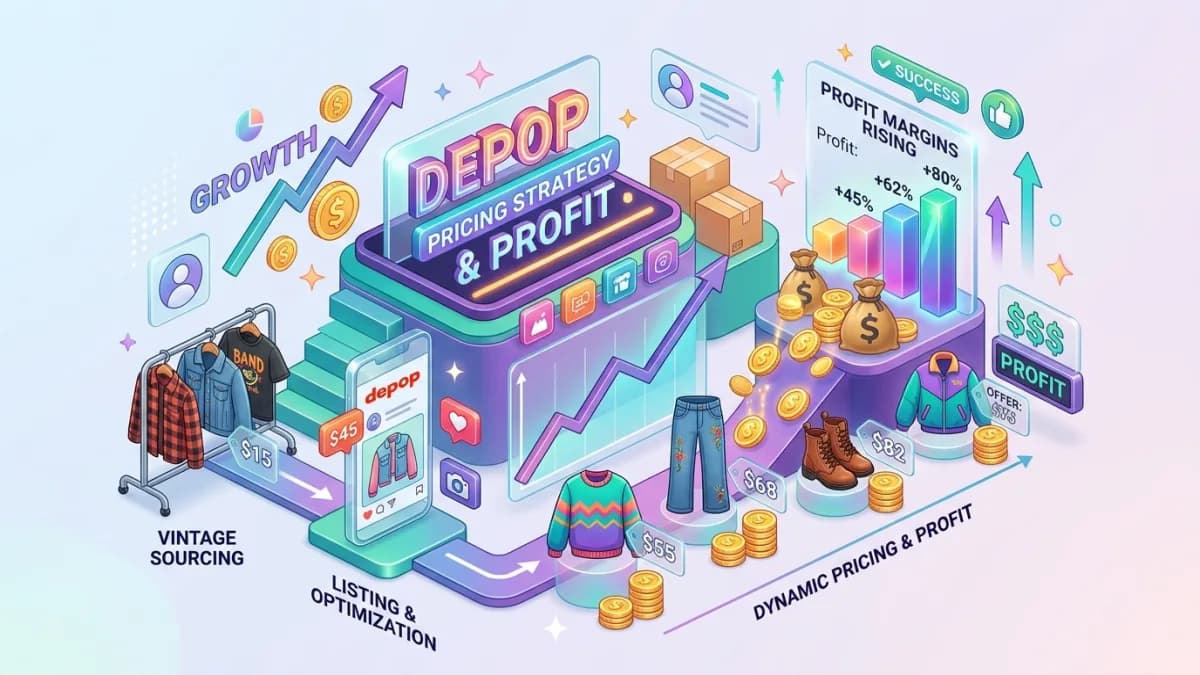
A Depop pricing strategy should produce a price the target buyer can accept and the seller can fulfil profitably. That requires more than adding a markup to acquisition cost.
The seller must account for condition, demand, comparable offers, location-specific fees, payment processing, shipping, packaging, promotion, returns, preparation, photography, storage, and offer behavior. Buyer-facing marketplace fees may also affect the total checkout cost in some markets.
Because Depop fees and features vary by location and can change, the safest method is to build a pricing worksheet with current account-specific inputs instead of copying a universal percentage from social media.
For sellers managing Depop alongside Etsy, eBay, Shopify or WooCommerce, this pricing work should sit beside competitor research, buyer research and Product Page Optimization, because price, keywords, photos and buyer intent need to support each other.
Last reviewed: 23 August 2026. Verify all fee inputs against the current Depop Help Centre and the seller's own transaction receipts before pricing.
Key Takeaways
- Research comparable sold and active listings, but match brand, garment, size, condition, market, and season.
- Calculate expected contribution, not revenue or markup alone.
- Use current seller-location, currency, payment, shipping, and promotion fees.
- Account for buyer checkout costs because they can affect offer behavior and conversion.
- Set target, list, offer-floor, bundle, and clearance prices before publishing.
- Include preparation and selling labour.
- Treat shipping as part of the commercial offer even when the buyer pays separately.
- Boost only listings with adequate conversion and contribution.
- Use received-offer data to diagnose demand and price, not as an instruction to accept every offer.
- Reprice according to inventory age and evidence.
- Never create fake discounts or misleading urgency.
- Review actual receipts and cohort profit monthly.
Start With Four Prices
Every listing should have four controlled values.
Target price
The realistic amount expected after normal negotiation.
List price
The displayed price. It may include reasonable negotiating space, but should remain credible and truthful.
Offer floor
The lowest amount an authorized seller can accept while meeting the required contribution.
Exit price
The price or alternative action used when inventory reaches a defined age: clearance, bundle, move channel, donate, recycle, or retain.
A list price without an offer floor leads to emotional decisions.
Build the Product Cost Record
Record all cost before choosing price.
| Cost group | Examples |
|---|---|
| Acquisition | Purchase, auction premium, inbound transport |
| Preparation | Cleaning, repair, steaming, authentication |
| Presentation | Photography, model, props, measurements |
| Listing | Research, copy, data entry |
| Platform | Selling, processing, boosting |
| Fulfilment | Packaging, label, insurance, shipping subsidy |
| Risk | Returns, refunds, loss, damage, fraud |
| Operations | Storage, software, staff handling |
| Tax | Applicable business obligations |
For sourced bundles, allocate cost consistently. Equal allocation may distort profit when one item carries most of the value.
Example weighted allocation:
`text
Allocated item cost =
bundle acquisition cost
× estimated item resale value
/ total estimated resale value of bundle
`
Document estimates and replace them with actual results over time.
Verify Current Depop Fees
Depop's current seller fees and charges are location-dependent.
As of the review date, the official page states:
- UK, US, and Australian sellers are not charged a Depop selling fee.
- Payment processing rates differ across those markets.
- Sellers outside those markets may be charged a 10% Depop selling fee under the conditions described by Depop.
- PayPal processing outside supported Depop Payments markets can depend on location and account.
- Boosting is an additional fee when attribution conditions are met.
- Fee bases can include item price and, in some cases, seller-arranged shipping.
- Refund handling differs by payment route.
Do not turn this dated summary into a permanent calculator.
Fee worksheet
Record:
| Input | Value/source |
|---|---|
| Seller country | |
| Listing currency | |
| Payment route | |
| Selling fee | |
| Processing percentage | |
| Processing fixed fee | |
| Boost rate | |
| Fee basis includes shipping? | |
| Fee basis includes tax? | |
| Shipping method | |
| Refund reversal behavior | |
| Verified date | |
| Receipt example |
Use the fee table that applies to the actual account and transaction.
Understand Buyer Checkout Cost
In some markets, Depop applies a marketplace fee to the buyer. The current marketplace-fee guidance says applicable UK and US purchases may include a percentage and fixed amount shown at checkout.
The seller may not control the exact fee, but buyer total affects affordability.
Evaluate:
`text
Buyer total =
item price
+ shipping
+ buyer marketplace fee where applicable
+ tax/duties where applicable
`
Do not advertise an exact total you cannot know. Consider checkout friction when interpreting low conversion or aggressive offers.
Calculate Expected Contribution
Use current verified rates.
`text
Expected contribution =
accepted item price
+ shipping collected
- allocated product cost
- preparation
- selling fee
- payment processing
- boosting fee when attributed
- packaging
- actual shipping
- expected return/refund allowance
- labour
- software/overhead allocation
- applicable tax cost
`
Illustrative example
The following is not a representation of current fees.
| Component | Amount |
|---|---|
| Accepted item price | $52.00 |
| Shipping collected | $8.00 |
| Product and inbound cost | -$14.00 |
| Preparation | -$3.00 |
| Illustrative platform/processing | -$3.00 |
| Packaging and shipping | -$9.00 |
| Return allowance | -$2.00 |
| Labour allocation | -$8.00 |
| Expected contribution | $21.00 |
If boosting could apply, calculate a separate boosted scenario.
Calculate the Minimum Acceptable Price
When percentage fees apply to the accepted price, work backward.
Let:
- C = all non-percentage costs
- F = fixed transaction fees
- r = total applicable percentage rate expressed as a decimal
- M = required contribution
- S = shipping collected minus shipping-related costs not already in C
A simplified item-price floor is:
`text
Minimum item price =
(C + F + M - S)
/ (1 - r)
`
Build the actual formula around each fee's true basis. Some percentages may apply to shipping or tax and others may not.
Round up, then test whether the market supports the result.
Research Comparable Prices
Search for the exact product or a defensible comparable group.
Match:
- Brand
- Product type
- Model or collection
- Era
- Material
- Size
- Colour
- Condition
- Country/market
- Shipping treatment
- Season
- Seller trust
- Included items
Record:
- Active asking prices
- Sold evidence where available
- Price plus shipping
- Likes and age only as contextual signals
- Offer patterns from your shop
- Availability of close substitutes
Active price is not realized price. A heavily liked item can still be overpriced.
Use a comparable hierarchy
- 1Exact item, same condition and market
- 2Exact item, adjusted condition
- 3Same brand and highly similar design
- 4Same product type, material, era, and demand
- 5Replacement-cost or alternative-channel evidence
Record the adjustment rather than selecting the most attractive comparable.
Price for Condition
Create a repeatable condition standard.
Possible internal grades:
- New with tags
- New without tags
- Excellent pre-owned
- Good pre-owned
- Fair/wearable
- Repair/project
- Unsellable
Define each grade and then disclose the actual condition rather than relying on the label.
Adjust for:
- Stain
- Hole
- Pilling
- Odour
- Fading
- Missing hardware
- Alteration
- Repair
- Fabric weakness
- Label condition
- Incomplete set
Do not price from a pristine comparable when the item has material damage.
Include Measurement and Fit Risk
Fashion returns and disputes can result from ambiguous fit.
Record:
- Label size
- Internal standardized size if used
- Garment measurements
- How measurements were taken
- Model measurements where relevant
- Stretch
- Intended fit
- Alterations
Do not change the labeled size merely to fit search trends. Use clear description and measurements.
Better measurement evidence may support price by reducing buyer uncertainty.
Set Negotiating Space
List-price padding should be based on observed offer behavior and buyer total.
Example:
- Target accepted price: $48
- Offer floor: $42
- Planned list price: $54
- Automatic or manual counter rule: maintain at least $42
Do not set $90 merely to “discount” to $48. Fake reference prices can undermine trust and may raise consumer-protection issues.
Offer policy
Define:
- Minimum acceptable contribution
- Maximum percentage discount
- Item-age adjustment
- Bundle interaction
- Boost interaction
- Who can approve exceptions
- Response window
- Counteroffer rule
- When to decline without countering
Review actual accepted, rejected, expired, and countered offers.
Evaluate Offers
An offer is information about one buyer, not automatically the market.
Before accepting:
- 1Recalculate fees at offered price.
- 2Confirm shipping destination and expected cost.
- 3Check whether boosting attribution could apply.
- 4Review inventory age.
- 5Review replacement difficulty.
- 6Compare target and floor.
- 7Check bundle or repeat-buyer context.
- 8Confirm the item remains available.
- 9Avoid off-platform payment requests.
Do not accept an offer that creates negative contribution solely to increase sales count.
Use Discounts Truthfully
A discount should have a business purpose.
Possible reasons:
- Seasonal campaign
- Inventory-age threshold
- Bundle incentive
- End-of-line clearance
- Controlled acquisition test
Record:
- Original normal selling price
- Discounted price
- Start/end
- Eligible items
- Required contribution
- Result
Avoid continuous rotating sales that create a false reference price.
Measure discount effect
Compare:
- Views and clicks
- Offers
- Conversion
- Accepted price
- Contribution
- Days to sale
- Return rate
- Incremental sales vs natural demand
Revenue growth can hide contribution decline.
Bundle Pricing
Bundles can improve order economics by sharing payment, packing, and shipping effort. They can also create unexpected shipping and fee outcomes.
Calculate:
`text
Bundle contribution =
bundle item revenue
+ shipping collected
- combined item costs
- applicable fees
- actual packaged shipping
- packaging
- expected return allowance
- handling labour
`
Weigh the complete packed bundle. Do not assume two items cost the same to ship as one.
Set bundle rules:
- Eligible products
- Discount by item count
- Maximum weight/dimensions
- Minimum contribution
- Combined-shipping method
- Return handling
- Excluded high-risk products
Shipping Strategy
Choose between Depop-provided shipping options and seller-arranged shipping according to current market availability and business needs.
Audit:
- Packed weight
- Packed dimensions
- Label/service
- Tracking
- Insurance
- Delivery expectation
- Packaging
- International eligibility
- Remote area cost
- Return address
- Lost/damaged procedure
Free shipping
“Free” shipping means the cost is absorbed in price or margin. Model buyer total and contribution.
Separate shipping
Can make item price appear lower but increases checkout total. Ensure the charge reflects the service and current policies.
Shipping undercharge
A small error repeated across many orders can erase profit. Weigh packaged representative items and review label adjustments.
Boosted Listings
Depop's current Boosted Listings guidance describes location-dependent rates and a 28-day attribution window after a buyer sees a boosted placement. Attribution can remain after unboosting.
Before boosting, calculate:
- Organic contribution
- Boosted contribution
- Minimum boosted accepted price
- Expected attribution
- View/click increase
- Conversion
- Incremental sales
- Inventory depth
- Return impact
Boosting a listing with poor photos, weak relevance, unclear measurements, or an uncompetitive buyer total can buy exposure without fixing conversion.
Boost test
- 1Choose comparable listings.
- 2Record baseline.
- 3Boost a defined group.
- 4Keep price and listing stable.
- 5Track views, clicks, sales, attributed fees, and contribution.
- 6Compare with a control group where possible.
- 7Stop based on economics, not vanity metrics.
Inventory Age and Markdown Rules
Create age bands appropriate to the category.
Example:
| Age | Review action |
|---|---|
| 0–30 days | Validate impressions, saves, questions |
| 31–60 days | Diagnose image, query, price, offer |
| 61–90 days | Test reprice, bundle, or alternate channel |
| 91–180 days | Clearance or strategic hold decision |
| 180+ days | Liquidate, donate, recycle, archive, or documented hold |
Vintage rarity may justify longer holds, but storage and capital still have cost.
Do not relist solely to create artificial freshness without improving the underlying offer and following platform rules.
Return and Refund Allowance
Use shop data.
`text
Return allowance per sale =
total return, refund, loss and damage cost
/ completed sales
`
Segment by product type. Footwear may carry different risk from accessories.
Include:
- Refund not recovered
- Return shipping
- Original shipping loss
- Damage
- Cleaning/repair
- Labour
- Item value loss
- Fees not reversed
- Fraud/dispute cost
Update the allowance monthly or quarterly.
Labour and Capacity
Track minutes for:
- Sourcing
- Cleaning/repair
- Measurement
- Photography
- Listing
- Messaging
- Packing
- Post-sale issue
- Return
`text
Labour cost per item =
total minutes / 60
× loaded hourly value
`
Even an owner-operated shop should track labour. Otherwise growth can mean more unpaid work.
Pricing Dashboard
Track by SKU and cohort:
- List price
- Accepted price
- Discount
- Shipping collected/cost
- Selling fee
- Processing fee
- Boost fee
- Product/preparation cost
- Return allowance
- Labour
- Contribution
- Days listed
- Offer count and range
- Source
- Category
- Reason for markdown
Reconcile estimates with transaction receipts.
100-Point Pricing Audit
| Area | Points |
|---|---|
| Current fee verification | 15 |
| Complete product cost | 15 |
| Comparable market evidence | 15 |
| Shipping accuracy | 10 |
| Offer and discount rules | 10 |
| Boost economics | 10 |
| Return and labour allowance | 10 |
| Contribution and price floor | 10 |
| Measurement and inventory age | 5 |
A price below the approved contribution floor or based on outdated material fees is a critical failure.
Final Checklist
- [ ] Seller market, currency, and payment route recorded
- [ ] Current fees verified from Depop
- [ ] Receipt checked against worksheet
- [ ] Buyer total considered
- [ ] Product and preparation cost allocated
- [ ] Comparable market researched
- [ ] Condition and measurements documented
- [ ] Shipping weighed and costed
- [ ] Return allowance included
- [ ] Labour included
- [ ] Organic and boosted scenarios calculated
- [ ] Target, list, floor, and exit prices set
- [ ] Offer and bundle rules defined
- [ ] Discount is truthful
- [ ] Inventory-age review scheduled
- [ ] Actual contribution reconciled monthly
Frequently Asked Questions
Does Depop charge sellers a fee?
It depends on seller location, currency, payment route, shipping, and promotion. Current Depop guidance says UK, US, and Australian sellers have no Depop selling fee, while other sellers may have a 10% selling fee under stated conditions. Verify the live fee page.
How much should I leave for offers?
Base negotiating room on target price, observed offer behavior, buyer total, and minimum contribution. Avoid arbitrary padding.
Is free shipping better?
Not universally. Compare buyer total, conversion, actual label cost, fee basis, and contribution.
Is boosting worth it?
Only when incremental profitable sales justify attributed fees. Test on conversion-ready listings and measure contribution.
Should I accept a low offer on old inventory?
Recalculate contribution, consider age and exit policy, and accept only if it fits a deliberate inventory decision.
How do I price a vintage item with no exact comparable?
Use a hierarchy of close comparables, document condition and rarity adjustments, set a conservative test price, and learn from offers and engagement.
Why does a profitable-looking sale lose money?
Common missing costs include processing, boost attribution, shipping, packaging, returns, preparation, labour, and buyer-driven price pressure.
Final Recommendation
Build the price from verified inputs.
Research comparable demand. Calculate buyer total. Use current location-specific fees. Cost shipping, returns, and labour. Set the offer floor before negotiation. Separate organic and boosted economics. Review inventory age and reconcile every estimate with actual receipts.
A strong Depop pricing strategy does not maximize the displayed price or sales count. It creates truthful offers that buyers accept while preserving enough contribution to operate the shop reliably.
Related posts
Shopify vs WooCommerce Checkout Comparison
A practical checkout comparison for store owners choosing between Shopify and WooCommerce.
Read article →

E-commerce Requirements Workshop: Discovery and Approval
Turn stakeholder assumptions into an approved e-commerce brief using sample orders, decision logs and testable acceptance criteria.
Read article →

Sales Tax and VAT for Online Stores Selling to the US, UK and EU
A practical guide to cross-border tax for online stores: US economic nexus after Wayfair, marketplace facilitator rules, the EU OSS and IOSS schemes, UK VAT on goods up to £135, and how Shopify and WooCommerce handle collection.
Read article →
Author
Anushka Dahanayake
Anushka Dahanayake builds SEO-focused websites, e-commerce platforms, dashboards, and automation systems for businesses worldwide.