
Marketplace Competitor Analysis Guide for Sellers
A practical guide to understanding why competing Etsy, eBay, Shopify or marketplace listings may be winning more visibility.
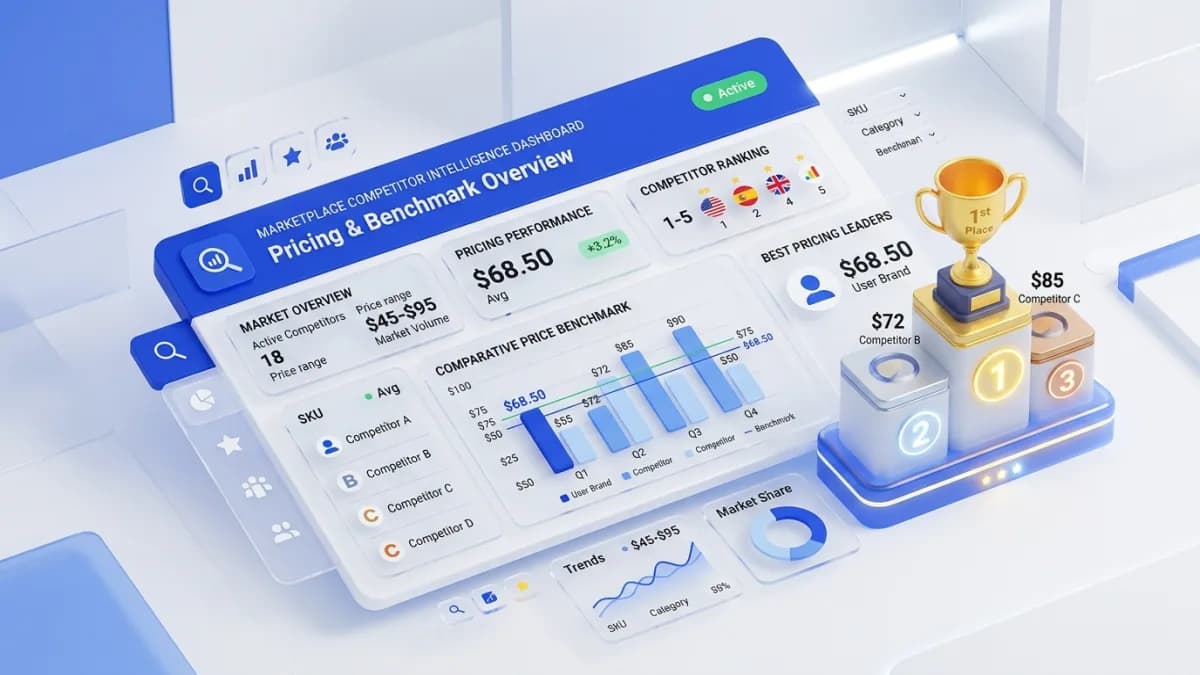
A competitor's listing can look successful without revealing why it sells, what it costs to operate, or whether the seller is profitable. Useful competitor analysis separates visible facts from interpretation and turns the findings into decisions for your own catalog.
The purpose is not to imitate every title or undercut every price. Marketplace competitor analysis should identify meaningful gaps in product presentation, offer design, fulfillment, and search relevance that your business can address credibly.
Define the Comparison Set
Choose competitors serving the same buying situation, not only sellers offering an item with a similar name. A handmade ceramic mug, a personalized gift mug, and a low-cost promotional mug can compete in different contexts despite sharing a product category.
Include direct competitors, premium alternatives, budget options, and substitutes where relevant. Keep the set small enough to examine deeply. A spreadsheet of hundreds of listings is not inherently more useful than a careful comparison of representative offers.
Record the date, marketplace, location, currency, search phrase, and filters used. Availability and search results can change. Without that context, a later reviewer cannot tell whether differences reflect seller changes or a different browsing situation.
Distinguish Observation From Inference
Visible facts include price, image count, stated handling time, available options, and review text. Inferences include why a seller ranks, how much profit they make, and which advertising channels drive orders.
Keep separate columns for observed evidence and interpretation. A listing with many reviews has accumulated feedback; it does not prove the current monthly sales rate. A sponsored placement indicates advertising visibility, not necessarily strong organic performance.
Etsy's explanation of search describes query matching and ranking as distinct stages and notes that results are personalized. Searching for your own listing is therefore a limited diagnostic, not a definitive measurement of its position for every buyer.
Use authorized marketplace research tools where available. eBay's Product Research guidance explains a seller research tool for examining marketplace sales information. Check its current access conditions and filters, and retain the selected period when reporting findings.
Compare Product Identity and Search Relevance
Read the title, category, attributes, description, and first image together. Do they describe the same item? Does the listing use the language buyers would use to identify material, style, compatibility, condition, or intended use?
For a vintage jacket, relevant details might include garment measurements, era evidence, fabric, condition, and sizing caveats. A long string of fashionable words cannot replace those facts. The seller may be attracting unsuitable visits if the title implies an inaccurate fit or period.
Identify gaps in your own structured fields before rewriting prose. Missing item specifics can affect filtering and buyer understanding. Marketplace requirements differ, so do not paste the same tag strategy into every platform.
The product-page SEO guide provides a useful owned-store comparison: product facts need to support both search interpretation and the customer's decision.
Inspect the Image Sequence as a Sales Explanation
Look at what each photograph answers. Does the first image identify the item clearly? Do later images show scale, condition, texture, contents, or personalization? Are essential defects visible for used products?
A competitor may appear more expensive while providing much better evidence. A buyer can evaluate the item with less uncertainty and fewer messages. That is a presentation difference worth testing in your own work.
Do not copy photographs, diagrams, or distinctive creative. Record the question an image answers, then create original material for your product. For example, photograph your own bag's internal compartments instead of reproducing another seller's composition.
Check mobile readability. Tiny labels on an infographic may be visible in a research spreadsheet but unreadable in the actual marketplace experience. Evaluate the listing as customers encounter it.
Normalize Prices Before Drawing Conclusions
Compare delivered offers with matching quantities, condition, options, and service levels. Record whether tax, shipping, customization, or accessories change the amount. A displayed starting price may represent the least expensive variant rather than the photographed configuration.
For an illustrative candle comparison, normalize container size and approximate product quantity where reliable information exists. Note differences in packaging and gift services separately. Do not invent a per-use value without verified performance information.
Estimate your own contribution at candidate prices. Competitor costs are usually unknown. They may have different sourcing, shipping contracts, advertising spend, or objectives. Matching their price without understanding your economics is not a strategy.
Treat promotions carefully. A temporary discount does not necessarily establish the normal market price. Record the observed offer and revisit if pricing is central to the decision.
Read Reviews for Tradeoffs
Group feedback into themes such as accuracy, durability, packaging, sizing, delivery, and communication. Include positive comments as well as complaints. Positive themes reveal what buyers value enough to mention.
Consider review context and recency. A shipping complaint during an exceptional disruption may not describe normal service. A product may have changed since an older review. Avoid treating a handful of comments as a statistically representative survey.
Translate themes into research questions. Repeated confusion about dimensions suggests testing a clearer scale explanation. Complaints about assembly may suggest better instructions or a different product design. The appropriate response depends on what your business can genuinely provide.
Do not contact competitor customers using personal information collected from reviews. Public feedback can inform aggregate analysis without becoming a prospecting database.
Compare Fulfillment and Trust Signals
Record handling times, destination restrictions, tracking information, returns, and support expectations. A competitor's apparent advantage may be operational rather than editorial. Faster dispatch cannot be reproduced by changing a headline if your stock is made to order.
Inspect how policies are explained. Buyers may favor a listing because the seller makes a difficult decision understandable. A concise customization approval process can reduce uncertainty even when production takes longer.
eBay's Best Match guidance discusses listing quality and seller performance considerations. Use official guidance to distinguish supported platform factors from unsupported claims about algorithm tricks.
Convert Findings Into a Ranked Action List
Write each opportunity as a specific change with supporting evidence. Replace add more trust with show the actual packaging and explain the dispatch process beside the delivery estimate. Name the affected listings and the person responsible.
Separate corrections from experiments. An incorrect measurement needs correction. An alternative first image is a hypothesis to evaluate. A new delivery service may require operational costing before any listing change.
Prioritize gaps that affect important buying decisions and are feasible to address. A smaller seller may win through specialized product knowledge or clearer customization, even when matching a large competitor's delivery network is unrealistic.
The multi-channel marketplace guide helps place those decisions within a broader channel plan. Avoid expanding solely because competitors appear on more platforms.
Keep the Review Current Without Obsessive Monitoring
Set review triggers around major product changes, new markets, pricing decisions, or sustained performance shifts. Constantly checking competitor pages can consume time without improving the offer.
Preserve a dated baseline and document what changed in your own listings. Compare subsequent performance with appropriate caution about seasonality, advertising, and stock. A competitor analysis produces informed hypotheses; it does not prove that copying an observed element will reproduce another seller's results.
Frequently Asked Questions
Should we always match the cheapest seller?
No. Compare the complete offer and your contribution first. A sustainable difference in quality, suitability, customization, or service may justify a different price when it is clearly explained.
Can public listings reveal competitor conversion rates?
Usually not reliably. Use available platform research within its documented limits, and label estimates as estimates. Visible reviews, favorites, or search position cannot establish a precise conversion rate on their own.
Related posts

Product Page SEO Services Guide for E-commerce Brands
A practical guide to product page SEO services for Shopify, WooCommerce and marketplace-connected stores.
Read article →

Magento Migration Guide: Moving to Shopify or WooCommerce
A practical guide for Magento Open Source and Adobe Commerce merchants: support lifecycle triggers, Shopify vs WooCommerce vs staying, data inventory, redirect mapping at scale, and a cutover checklist.
Read article →

Wix or Squarespace to WordPress: An SEO-Safe Migration Guide
When leaving Wix or Squarespace for WordPress is worth it, what each platform actually lets you export, how to rebuild and redirect every URL, and how to monitor the move in Search Console.
Read article →
Author
Anushka Dahanayake
Anushka Dahanayake builds SEO-focused websites, e-commerce platforms, dashboards, and automation systems for businesses worldwide.